
The market resolves to the period containing the first date on which a space-based computing facility meets ALL of the following:
Power: At least 1 MW of electrical power dedicated to computing payloads (not total bus power). A single spacecraft or a constellation explicitly operated as one integrated compute cluster (e.g., optically interconnected and marketed/operated as a single facility) both qualify. Aggregating unrelated satellites does not.
Operational: The facility has performed commercial or institutional computing workloads for at least 30 consecutive days. Demonstrators count only if serving external customers or sustained internal production workloads (e.g., the operator's own training/inference).
In space: Earth orbit, cislunar space, or the lunar surface.
Verification: Credible public evidence — operator announcements with technical detail, regulatory filings, independent reporting from at least two reputable outlets (SpaceNews, Ars Technica, DCD, etc.), or third-party tracking data consistent with the claims.
The qualifying date is when the 30-day operational period is completed. If evidence is disputed, I may wait up to 3 months for clarification before resolving.
Criteria updates: Given the long time horizon and how fast this industry is evolving, I reserve the right to clarify or refine these criteria over time (e.g., how to count constellation power, edge cases on what constitutes "one facility"), always in the spirit of the original question and never to flip an outcome that has already clearly occurred. Any clarification will be announced in a comment and added to this description with a date stamp.
 1,000
1,000People are also trading
Be serious people, no convective cooling in space! That's the main issue regardless of how wacky the funders are, and that applies to water cooling and other types too. There's no need for more reasons, but … minimal maintenance, ridiculous maintenance cost, ridiculous deployment cost, nobody will pay the cost to use them, hard to build stuff there, staff issues, super high usage cost and soo slow, more problems with cosmic rays and solar wind, bandwidth issues, no advantages! China is building some in the ocean, that actually makes sense if you want one in an exotic environment.
@AlanTennant I'm not sure why this seems to be the biggest source of scepticism, it seems like entirely a non-issue.
Are people just getting caught up in feeling clever because the "thermodynamics says no" argument often is a knockdown argument in a lot of contexts? But actually in this case it's totally fine.
Naive calculation says that about 100 square meters at 60°C radiating on both sides is adequate to dissipate 150kW which is what SpaceX are saying they're aiming for. So they're just gonna have a 100 square meter radiator - and indeed, SpaceX's draft design for their AI satellites has a 110 square meter radiator.
The Forethought institute has come to a similar conclusion in a well-researched report on the matter:
https://www.forethought.org/research/will-we-really-put-data-centers-in-space
Radiative cooling, often cited as a fatal obstacle, appears surprisingly manageable — potentially even cheaper than on Earth.
[...]
The cooling problem is more tractable than commonly assumed. Passive radiators using selective coatings and lightweight carbon fibre panels could achieve ~163–346 W/kg at system level, a 13-28× improvement over ISS-era radiators (~13 W/kg).5No radiator at these performance levels has been deployed at the scale an orbital data center would require, but prototype high-conductivity carbon composite panels have demonstrated the material properties required. At these performance levels, thermal hardware is 2-5% of total data center cost, and actually less than what terrestrial data centers spend on cooling over a comparable lifecycle.
And venerable YouTube rocket scientist Scott Manley came to similar conclusions a few months ago:
Is It Really Impossible To Cool A Datacenter In Space?
But really, the naive calculation tells you what you need to know: 100 square meters is enough. So they're just gonna do that. Why is that so implausible?
@chrisjbillington In my opinion the framing is incorrect. The real question is not whether building data centers in space is possible or impossible, but whether it is possible at costs competitive with ground-based data centers. My impression as a space engineer is that the technical obstacles are enormously underestimated.
@SpaceEngineer well per the Forethought analysis, the cooling in space is cheaper than on earth.
So whether or not orbital datacentres are economical obviously depends on other factors, but if Forethought are right, cooling cannot be the main issue.
I happen to think they will make economic sense, but mostly I wanted to push back on the cooling issue, it's not actually an issue
@chrisjbillington Why not keep them on earth where everything else works in your favour too, and given everything so far I'm sure we will. Scott Manning was great, but now has an odd blind spot when it comes to sinking massive costs into spaceX and other folly at this point. Even if they cool more efficiently there (they don't), you still wouldn't launch a server farm (that's what they are) into orbit.
@AlanTennant well not everything works in your favour on earth is the problem.
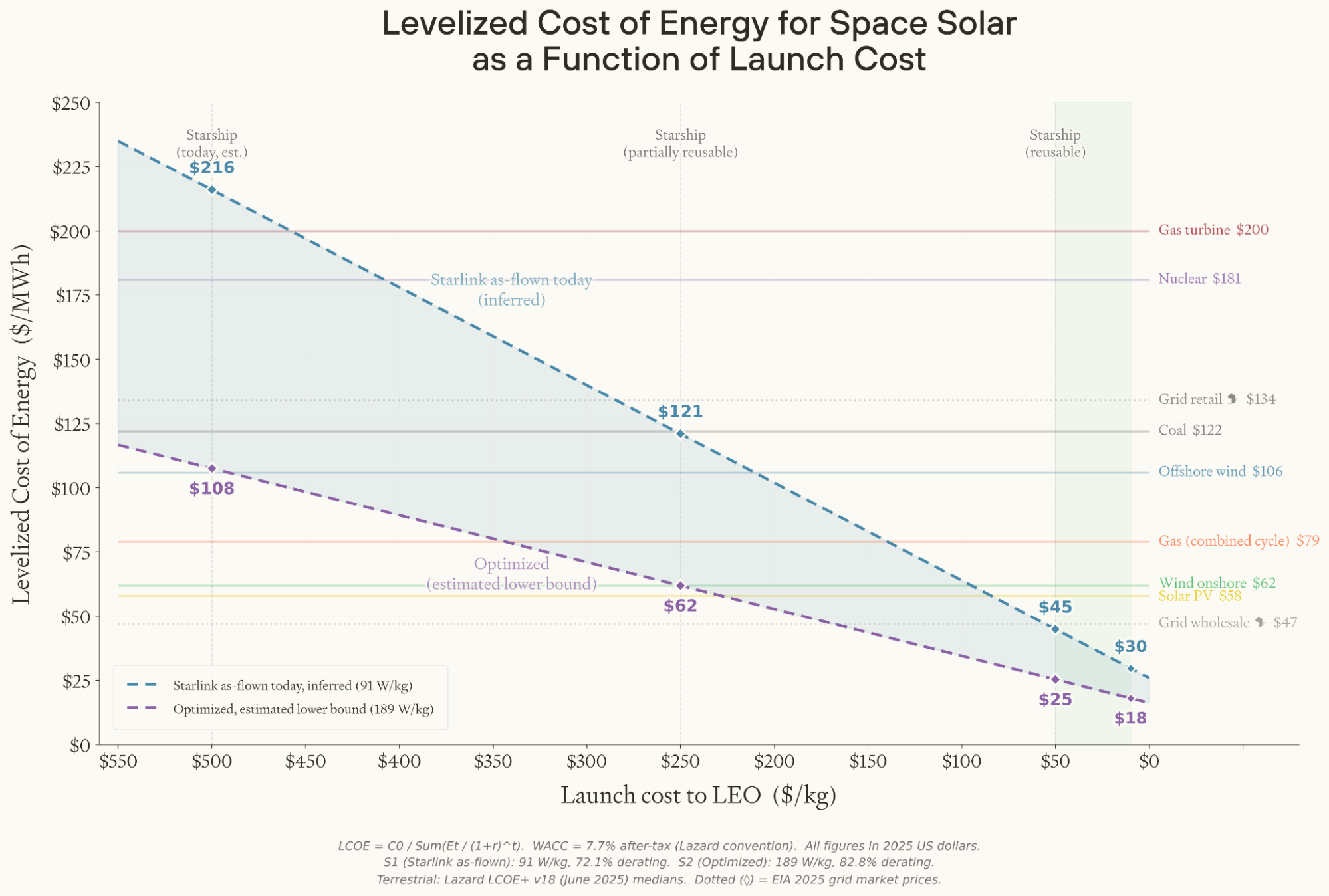
Cooling and power and both more expensive there, whereas the main cost of going to space is the launch cost - but that will be decreasing over the coming few years with Starship.
@chrisjbillington Starship didn't go to the moon, starship launched a banana, and various versions exploded lots of times, stop repeating billionaires justifications of why the company should be worth billions.
@chrisjbillington Well, the Forethought analysis is wrong. Cooling in space is way more expensive than on Earth and it will be a very long time before it becomes cheaper, if it ever does. I say that as a spacecraft thermal engineer, but you are welcome to believe them if you prefer. I agree that there also other issues that may be even harder to solve than cooling, though.
@SpaceEngineer they have some info on their reasoning, what do you find implausible about it, specifically?
Me I just see SpaceX are saying they're gonna put a 110 square meter radiator on the 150kW satellites, which roughly matches Stefan-Boltzmann for 60°C if you assume both sides are radiating. So I'm sure some clever engineering will have to go into making it light enough but Forethought's talk of low hanging fruit sounds plausible to me.
@chrisjbillington You can reject 150 kW with 110 * 2 square meters of radiators at 60 °C if:
- the surface emissivity is that of a black body
- the radiator temperature is perfectly uniform
- no other warm surfaces (the Sun, the Earth, other parts of the spacecraft) are in sight of either radiator face
None of these assumptions is true. In practice any space radiator is far less efficient than a black body. Believing that you can achieve that would be a bit like believing that you can build a thermal combustion engine with the efficiency of the Carnot cycle.
They assume almost 1400 W/m2 of heat rejection. In practice it is very difficult to go above 350 W/m2 and that only when some conditions are met. Maybe if they are exceptionally good they can get to 500 W/m2, but I highly doubt it on such a large structure. Then you have to add the thermal dissipation of the other parts of the spacecraft and to add some redundancy for the radiator parts that will break down or get damaged by micrometeoroids.
You’re looking not at 100 m2 of radiators but at something more like 500-1000 m2. With a similar power the International Space Station has 2500 m2 of radiators. You can do better than the ISS, but not ten times better. I would like to stress that these are obstacles that descend directly from the laws of physics, not technological problems that can be overcome with some R&D.
Then you have to add a similar area of solar panels.
When you have that type of areas the difficulties and costs in first integrating the spacecraft and then operating it are or an entirely different order of magnitude than on a Starlink satellite.
And don’t get me started on radiation protection.
It’s a lot more difficult than it sounds. Again, not absolutely impossibile, but far from straightforward or easier than on Earth.
@SpaceEngineer at the risk of disagreeing with someone who certainly should know better than me - well, just to interject on that point, most satellites don't have radiators, right? So whatever thermals you work on are presumably a bit different?
Anyway I thought they had special coatings that reject visible light and emit/absorb in the IR, which the chatbots tell me at 60°C would radiate 90% as much on full sunlight as in shadow.
I'm also under the impression the effective emmisivity of these things are like 0.8-0.9.
That doesn't sound like "far less efficient than a black body", it sounds like "almost as efficient".
The ISS panels run at like zero Celcius, at e.g. 60°C you get a factor of 2.2 right off the bat. I'd have to check the numbers otherwise though. What makes it so inefficient other than the low temperature? To be honest I am sympathetic to the idea that they might just not be that optimised given they were designed in the nineties.
Then you have to add the thermal dissipation of the other parts of the spacecraft
Well, this works in favour of cooling , right? E.g. starlink V2 mini satellites seem to dissipate maybe 20kW through just the body of the satellite, which given their area sounds like they're not far off radiating like a black body, certainly not an order of magnitude worse.
So maybe take 20kW off what needs to be dissipated by the radiator given the satellite body will probably be pretty similar to Starlink.
Reading between the lines, it sounds to me like you're implying larger radiators are worse per unit area because the heat needs to be pumped around in fluid, whereas I'm guessing starlinks cooling is entirely passive. And larger radiators mean more pumping.
Still, we've got Forethought saying prototypes already exist with the required material properties, Scott Manley made a video saying it's fine - he usually has excellent judgement of who to trust and his own knowledge is usually very reliable - and you're saying you're an expert but why the disagreement then? Naive physics says it's fine, the coatings exist, I don't know why ISS is so bad, could you elaborate? What stops you from getting close to black body?
@chrisjbillington Of course all satellites have radiators, if not how do you think they radiate heat to space? Maybe what you meant is that most satellites do not have deployable radiators. That would be true. Most spacecraft, including the Starlink ones, have body mounted radiators, because the area of the satellite itself is usually sufficient. That of course will not be true here.
I think the main factors that make the ISS radiators inefficient are indeed the low temperature and the spatial temperature gradients. Here you can gain something on the temperature level (certainly not 60 K), but not much on the temperature uniformity. As I said, it’s more a physical question than a technological one. One big improvement that we have achieved since the nineties is the solar absorptivity of the coatings. That will also improve things somehow, but will not completely change the picture.
All in all, as I said I am sure they can do better than the ISS (which is around 50-100 W/m2), but I don’t think they can get much above 350 W/m2.
Also I don’t understand why you believe that the heat generated by the spacecraft platform helps cooling. It’s all additional power that requires more radiator area.
Then, as I said, you have to add even more radiator area to compensate for partial failures and performance degradation over time.
Finally, the design data of the Starlink satellites are not publicly available, unfortunately, but I don’t think they dissipate 28 kW. That is maybe the peak power generated by the solar arrays. The actual average dissipated heat will be perhaps around 5 kW, with a radiator area of perhaps 15 m2. That is, keep in mind, with a much more efficient system than you can achieve on larger radiators (I assume Starlink uses constant conductance heat pipes to keep the radiators temperature uniform).
But the point is not the radiator area per se, it’s all the complications that go with it. Beyond thermal, there are a lot of other challenges, not insurmountable, but complicated and costly.
I won’t insist. As I said, you are free to believe that competitive space data centers are right behind the corner. In a few years we’ll see who wins this market.
Yes I meant deployable radiators. Since Starlink satellites manage to dissipate what looks like am amount of heat suggesting they're the majority of the way to being ideal black body radiators, they're an existence proof for efficient heat dissipation in general. So deployable radiators would have to be significantly worse to be much worse than ideal black bodies.
Also I don’t understand why you believe that the heat generated by the spacecraft platform helps cooling. It’s all additional power that requires more radiator area.
I'm not saying that, I had misunderstood you. I was saying the spacecraft body dissipates some heat and thus somewhat reduces the required area of the deployed radiator. Of course, SpaceX may prefer to just have a slightly larger radiator than bother having good thermal conduction to the satellite body.
I didn't realise you were adding up different sources of heat as I have already taken it as a given that when SpaceX says they're aiming for 150kW, that the total power consumption of the satellite, not just the GPUs. So there's nothing more to add.
but I don’t think they dissipate 28 kW. That is maybe the peak power generated by the solar arrays. The actual average dissipated heat will be perhaps around 5 kW, with a radiator area of perhaps 15 m2
If peak power generation is 28kW, then whilst some of the energy is emitted as microwave radiation and kinetic energy from thrusters, peak power dissipation must be the remainder, which will be the large majority, likely >90%. Radiator area must be big enough for peak dissipation, not average, average is irrelevant.
I'll be honest, your suggestion that a spacecraft with solar panels large enough to generate 20-30kW of power only has adequate cooling for 5kW makes me take you a lot less seriously. These numbers need to be nearly identical by simple energy conservation and you would know this if you work in the field. It's not like they would ship solar panels that generate 4-6× more energy than can be dissipated. So at this point I kind of flat out don't believe you have significant relevant experience in this field, either that or you're being extremely loose with the truth despite knowing better. Apologies if I am mistaken, but you're not making any sense here.
I've asked the chatbots by what factor state of the art space radiator tech in low earth orbit exposed to earth's heat, edge on to the sun, underperform the hypothetical isothermal black body radiator in deep shadow, and they're telling me it's like 0.7. Here is an example prompt and response:
https://claude.ai/share/4f2fb02e-a04f-41d6-8adf-41893d53a51d
Obviously chatbots don't know everything, but if radiator tech is so much worse than this, why would they not know it?
For what it's worth, the degradation over time doesn't really matter - it sounds like the chips dying reduces the power and cooling demand faster than the power and cooling capacity decline, so no margin for degradation needs to be included. Not until chip survival in space improves. I also think the chip death rate isn't enough to make the whole idea unprofitable, but that's a different direction of argument.
Also for what it's worth, I haven't bet in this market because the need for the cluster to be "integrated", I'm not super clear on what that means. If there are a hundred 150kW satellites operated by one company but coordinated computation across them isn't really practical, I don't know if that will count. If you assure me that it will I'd make some bets though!
@chrisjbillington All right mate, you would have saved me a lot of time if you said from the start that you were not going to believe me. By the way, if you can find anywhere any actual evidence (not AI slop) of any spacecraft on orbit right now with radiators dissipating more than, say, 500 W/m2, let me know, I will be very curious to learn about it. Bye.
@SpaceEngineer I owe you an apology, I made a simple mistake and wrote off your opinion based on it. Obviously for Starlink the power generation capacity exceeds even peak consumption, because it's in shadow sometimes and charging batteries. I was still stuck thinking about AI satellites which I'm guessing will have only small batteries and will only have compute load when in sunlight.
For Starlink, it sounds like solar capacity would need to exceed average consumption by about a factor of two. Still not a factor of five or six, but it was a way too strong statement for me to say these have to be equal. We still disagree, but for what it's worth I'm sorry.
@chrisjbillington All right, apology accepted. I am willing to share my experience (been a thermal engineer for almost 30 years) and I think this discussion can be useful for both of us, but please don't call me a liar again. Back to the topic at hand, you're right that a factor 5 or 6 between peak power and average power seems too high, generally the ratio is lower, but it depends on the operational profile. I once worked on an Earth observation satellite where the ratio between peak power and average power was more than 10, so it's not impossible. On the other hand, it's absolutely possible that the average power of the Starlink V2 satellites is much higher than 5 kW, but in that case I believe they would need a proportionally larger radiator area.
I think we can both agree that if SpaceX were capable of building radiators with 1000 W/m2 or more of heat rejection capability they would be doing that right now on their Starlink satellites, as large radiators are massive, cumbersome and costly. I absolutely don't believe they can, but if we found any positive evidence I would have to eay my words and I would want to learn how they do it. So as I said I would be very interested in finding more information about their thermal design.
@chrisjbillington Update: I found some information on the thermal design of the Starlink satellites. There are some interesting things, but nowhere near what would be necessary to achieve 1000 W/m2.
@chrisjbillington This is not the point, compute can be run in space and communicated with from earth, but everywhere on earth makes orders of magnitude more economic sense, to the point where it's guaranteed not going to happen.
@chrisjbillington It's not disclosed. The fact they tend to use COTS hardware suggests the temperature range is narrower than that of space-qualified equipment.