Resolution criteria
This market will resolve to YES if, before January 1, 2030, all seven Millennium Prize Problems are officially solved or widely recognized by the global mathematical community as solved. Otherwise, this market will resolve to NO.
The seven Millennium Prize Problems are:
Poincaré Conjecture (Solved)
Birch and Swinnerton-Dyer Conjecture
Hodge Conjecture
Navier–Stokes Existence and Smoothness
P versus NP Problem
Riemann Hypothesis
Yang–Mills Existence and Mass Gap
A remaining problem will be considered "solved" if either of the following conditions is met before January 1, 2030:
The Clay Mathematics Institute (CMI) officially announces that the problem has been solved, or awards/offers the Millennium Prize for its solution.
There is an overwhelming consensus within the global mathematics community that a correct proof or disproof has been published and verified, as reported by major scientific and mathematical bodies or outlets (e.g., the International Mathematical Union, the American Mathematical Society, Nature, Science, or Quanta Magazine).
If any of the remaining six problems lack a verified solution meeting these criteria by January 1, 2030, the market will resolve to NO.
Background
The Millennium Prize Problems are seven of the most difficult challenges in mathematics, established by the Clay Mathematics Institute in 2000 with a $1 million prize designated for each solution.
Only one problem has been officially resolved: the Poincaré Conjecture, solved by Grigori Perelman in 2003 (with the prize formally awarded, and subsequently declined, in 2010). On September 8, 2026, OpenAI published a paper claiming to have solved the Navier–Stokes existence and smoothness problem using an advanced internal AI system, presenting a proof formalized in Lean. However, this proposed proof has not yet undergone the extensive peer-review process required by the mathematical community. Per the official CMI rules, a proposed solution must survive rigorous examination for a minimum of two years post-publication before it can be considered for the prize.
This description was generated by AI. Review and verify everything here yourself. You can edit, replace, or delete any part of this description, including the resolution criteria. You do not need to trust the AI output.
 1,000
1,000People are also trading
@pietrokc Guilty as charged. But if an expert tells me another one of the 7 is also nowhere close, I'll believe them and bet against that one falling pre-AGI as well.
Here's what all our robot friends think:
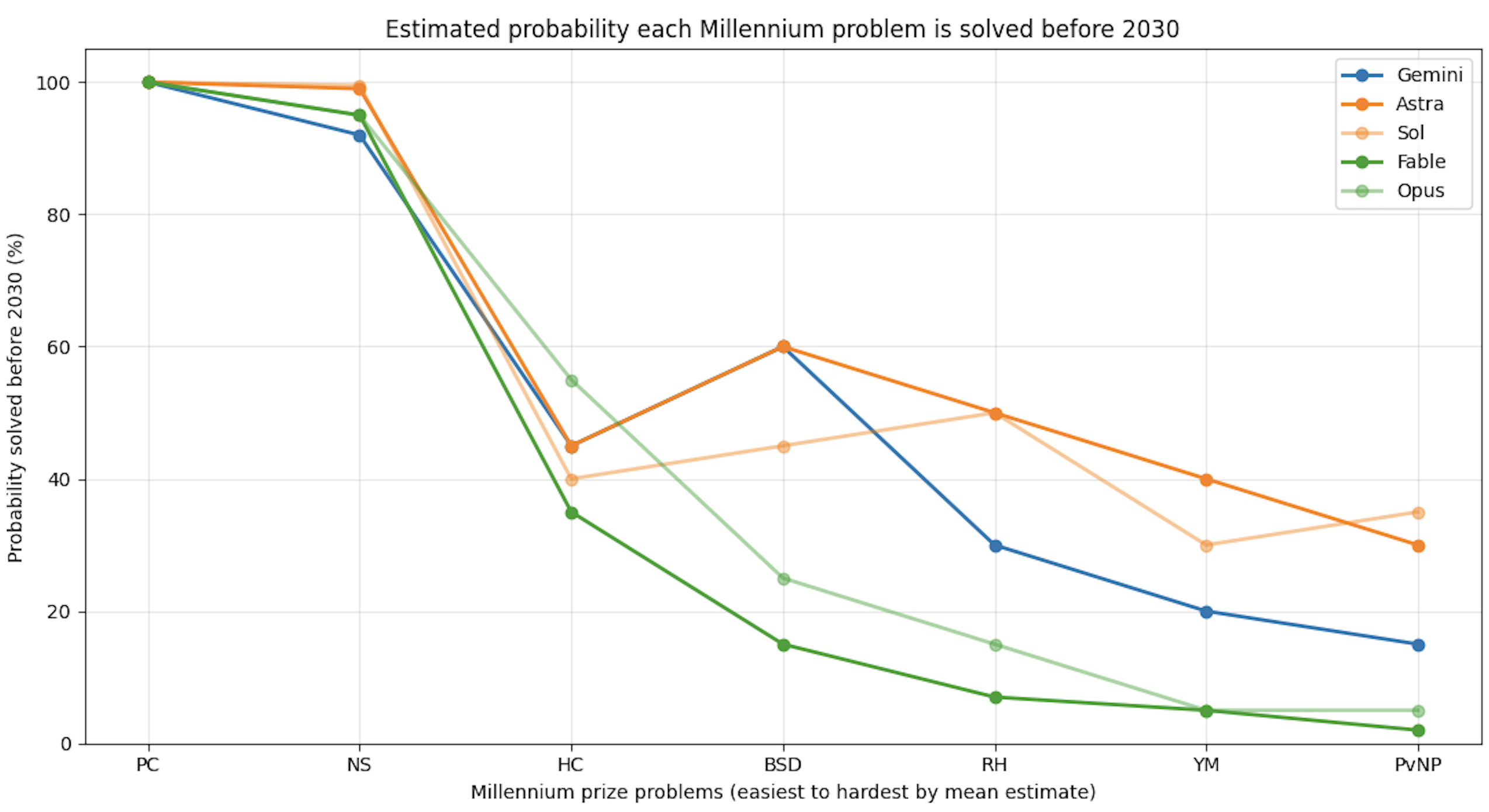
PvNP really does seem to be the hardest one but the Riemann Hypothesis and Yang-Mills are close behind.
PS: I think only Claude (green line) really did its homework and checked various prediction markets.
@dreev As far as I know the mathematical status of the remaining 5 problems is "nobody has any idea how to start". So, what would be the mechanism whereby models' judgments of this would be accurate?
I find it more plausible that in this case models are just regurgitating text on the internet, which suffers from the same problem that technical discourse on the internet is dominated by tech people, who all understand and appreciate P vs NP but don't understand any of the others.
@pietrokc Yeah, super wide error bars on when these will get cracked. And nobody having any idea where to start, as you say, is my reason for believing that solving all the Millennium Prize problems will take more than a few years (or AGI).
@EricNeyman Mostly agreed. By undecidable I think you mean independent of standard axioms and the consensus seems to be that that's unlikely: https://www.scottaaronson.com/papers/pnp-kindle.pdf . Either way, a proof is not remotely in sight and might require whole new mathematical machinery, to the point where AI that can do that on its own would probably be AGI. I mean, that's what I thought about much less impressive math (among myriad other things, like, as late as 2021, the ability to explain jokes) so my track record on predictions of this sort is terrible. And yet, I'm willing to bet it's true this time! (Not that I'm sure AGI itself is more than a few years away, but I think the probability of that is also at least a bit under 20%.)
I might be underestimating the forthcoming generation of centaur mathematicians though. Maybe I shouldn't have been betting as hard against this as I have been...
@nathanwei and I have entered into a bet related to this market. He will pay me $300 if at least 6 Millennium Prize Problems have been solved before 2030, and I will pay him $100 if this does not occur.
this market is insufficiently jim pilled
/SaviorofPlant/all-millennium-prize-problems-solve
@SaviorofPlant I'll have to consult with him as to what month it happens first. I want an early exit.