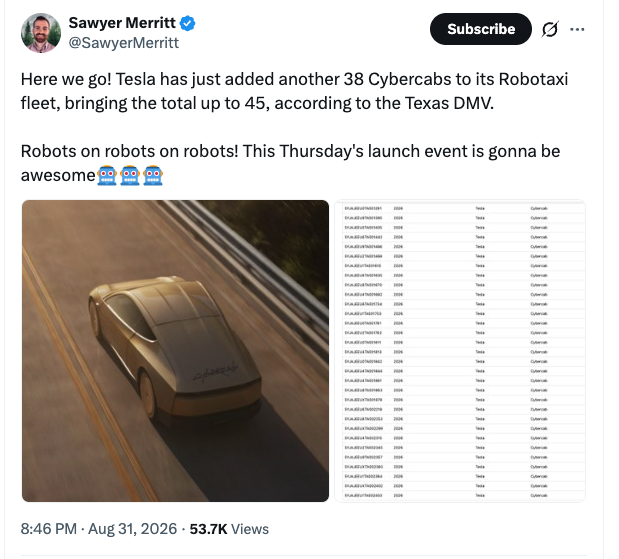
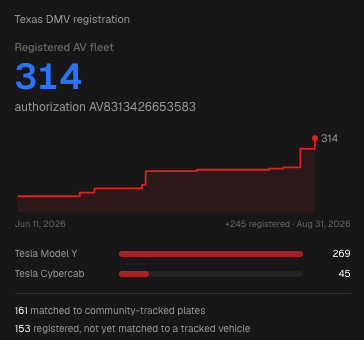
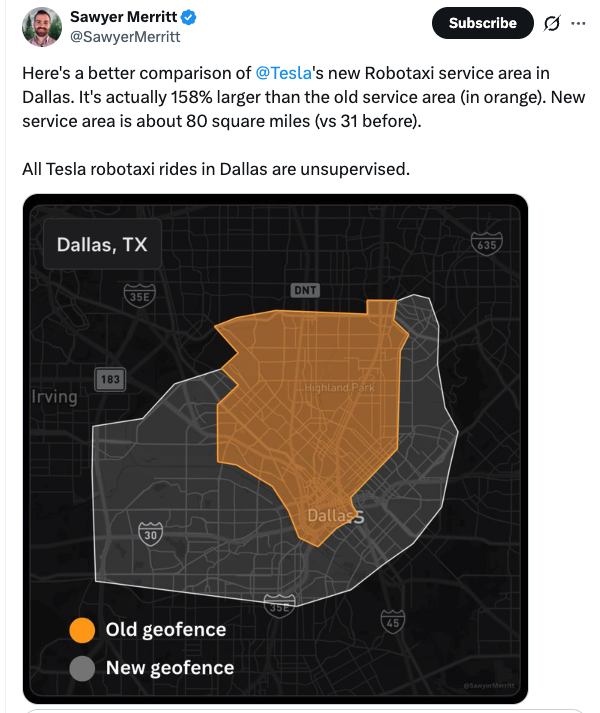
Elon Musk has been very explicit in promising a robotaxi launch in Austin in June with unsupervised full self-driving (FSD). We'll give him some leeway on the timing and say this counts as a YES if it happens by the end of August.
As of April 2025, Tesla seems to be testing this with employees and with supervised FSD and doubling down on the public Austin launch.
PS: A big monkey wrench no one anticipated when we created this market is how to treat the passenger-seat safety monitors. See FAQ9 for how we're trying to handle that in a principled way. Tesla is very polarizing and I know it's "obvious" to one side that safety monitors = "supervised" and that it's equally obvious to the other side that the driver's seat being empty is what matters. I can't emphasize enough how not obvious any of this is. At least so far, speaking now in August 2025.
FAQ
1. Does it have to be a public launch?
Yes, but we won't quibble about waitlists. As long as even 10 non-handpicked members of the public have used the service by the end of August, that's a YES. Also if there's a waitlist, anyone has to be able to get on it and there has to be intent to scale up. In other words, Tesla robotaxis have to be actually becoming a thing, with summer 2025 as when it started.
If it's invite-only and Tesla is hand-picking people, that's not a public launch. If it's viral-style invites with exponential growth from the start, that's likely to be within the spirit of a public launch.
A potential litmus test is whether serious journalists and Tesla haters end up able to try the service.
UPDATE: We're deeming this to be satisfied.
2. What if there's a human backup driver in the driver's seat?
This importantly does not count. That's supervised FSD.
3. But what if the backup driver never actually intervenes?
Compare to Waymo, which goes millions of miles between [injury-causing] incidents. If there's a backup driver we're going to presume that it's because interventions are still needed, even if rarely.
4. What if it's only available for certain fixed routes?
That would resolve NO. It has to be available on unrestricted public roads [restrictions like no highways is ok] and you have to be able to choose an arbitrary destination. I.e., it has to count as a taxi service.
5. What if it's only available in a certain neighborhood?
This we'll allow. It just has to be a big enough neighborhood that it makes sense to use a taxi. Basically anything that isn't a drastic restriction of the environment.
6. What if they drop the robotaxi part but roll out unsupervised FSD to Tesla owners?
This is unlikely but if this were level 4+ autonomy where you could send your car by itself to pick up a friend, we'd call that a YES per the spirit of the question.
7. What about level 3 autonomy?
Level 3 means you don't have to actively supervise the driving (like you can read a book in the driver's seat) as long as you're available to immediately take over when the car beeps at you. This would be tantalizingly close and a very big deal but is ultimately a NO. My reason to be picky about this is that a big part of the spirit of the question is whether Tesla will catch up to Waymo, technologically if not in scale at first.
8. What about tele-operation?
The short answer is that that's not level 4 autonomy so that would resolve NO for this market. This is a common misconception about Waymo's phone-a-human feature. It's not remotely (ha) like a human with a VR headset steering and braking. If that ever happened it would count as a disengagement and have to be reported. See Waymo's blog post with examples and screencaps of the cars needing remote assistance.
To get technical about the boundary between a remote human giving guidance to the car vs remotely operating it, grep "remote assistance" in Waymo's advice letter filed with the California Public Utilities Commission last month. Excerpt:
The Waymo AV [autonomous vehicle] sometimes reaches out to Waymo Remote Assistance for additional information to contextualize its environment. The Waymo Remote Assistance team supports the Waymo AV with information and suggestions [...] Assistance is designed to be provided quickly - in a mater of seconds - to help get the Waymo AV on its way with minimal delay. For a majority of requests that the Waymo AV makes during everyday driving, the Waymo AV is able to proceed driving autonomously on its own. In very limited circumstances such as to facilitate movement of the AV out of a freeway lane onto an adjacent shoulder, if possible, our Event Response agents are able to remotely move the Waymo AV under strict parameters, including at a very low speed over a very short distance.
Tentatively, Tesla needs to meet the bar for autonomy that Waymo has set. But if there are edge cases where Tesla is close enough in spirit, we can debate that in the comments.
9. What about human safety monitors in the passenger seat?
Oh geez, it's like Elon Musk is trolling us to maximize the ambiguity of these market resolutions. Tentatively (we'll keep discussing in the comments) my verdict on this question depends on whether the human safety monitor has to be eyes-on-the-road the whole time with their finger on a kill switch or emergency brake. If so, I believe that's still level 2 autonomy. Or sub-4 in any case.
See also FAQ3 for why this matters even if a kill switch is never actually used. We need there not only to be no actual disengagements but no counterfactual disengagements. Like imagine that these robotaxis would totally mow down a kid who ran into the road. That would mean a safety monitor with an emergency brake is necessary, even if no kids happen to jump in front of any robotaxis before this market closes. Waymo, per the definition of level 4 autonomy, does not have that kind of supervised self-driving.
10. Will we ultimately trust Tesla if it reports it's genuinely level 4?
I want to avoid this since I don't think Tesla has exactly earned our trust on this. I believe the truth will come out if we wait long enough, so that's what I'll be inclined to do. If the truth seems impossible for us to ascertain, we can consider resolve-to-PROB.
11. Will we trust government certification that it's level 4?
Yes, I think this is the right standard. Elon Musk said on 2025-07-09 that Tesla was waiting on regulatory approval for robotaxis in California and expected to launch in the Bay Area "in a month or two". I'm not sure what such approval implies about autonomy level but I expect it to be evidence in favor. (And if it starts to look like Musk was bullshitting, that would be evidence against.)
12. What if it's still ambiguous on August 31?
Then we'll extend the market close. The deadline for Tesla to meet the criteria for a launch is August 31 regardless. We just may need more time to determine, in retrospect, whether it counted by then. I suspect that with enough hindsight the ambiguity will resolve. Note in particular FAQ1 which says that Tesla robotaxis have to be becoming a thing (what "a thing" is is TBD but something about ubiquity and availability) with summer 2025 as when it started. Basically, we may need to look back on summer 2025 and decide whether that was a controlled demo, done before they actually had level 4 autonomy, or whether they had it and just were scaling up slowing and cautiously at first.
13. If safety monitors are still present, say, a year later, is there any way for this to resolve YES?
No, that's well past the point of presuming that Tesla had not achieved level 4 autonomy in summer 2025.
14. What if they ditch the safety monitors after August 31st but tele-operation is still a question mark?
We'll also need transparency about tele-operation and disengagements. If that doesn't happen by June 22, 2026 (a year after the robotaxi launch) then that too is a presumed NO.
Ask more clarifying questions! I'll be super transparent about my thinking and will make sure the resolution is fair if I have a conflict of interest due to my position in this market.
[Ignore any auto-generated clarifications below this line. I'll add to the FAQ as needed. Text in brackets is my own voice.]
[Apparently I said in a comment on 2025-11-01 something about wanting to see a roughly exponential deployment graph in the year following the launch and that a flat graph would suffice for NO? Not that what I say off-hand in comments counts if I don't add it to the FAQ. But do grill me if I contradict myself at all!]
[On 2025-12-10 we talked about Elon Musk's November 6th, 2025 statement: "Now that we believe we have full self-driving / autonomy solved, or within a few months of having unsupervised autonomy solved... We're on the cusp of that" which sure sounds like admitting they weren't at level 4.]
[More discussion on 2026-01-31 of the possible passenger-seat emergency stop button and how it depends on how real-time it is.]
[On 2026-02-01 I apparently proposed that on June 22, 2026, we could resolve NO if we still didn't have transparency on all the ways Tesla could potentially be cheating. And that if Tesla started shooting past Waymo by then, that might start looking like a YES.]
[On 2026-02-02 I apparently defined supervision as a human in the loop in real time, watching and ready to intervene. And real-time disengagement means the human controlling the car in some way. The car getting stuck and asking for help is not a real-time disengagement.]
[Also on 2026-02-02 I apparently had some preliminary analysis suggesting robotaxis were subhumanly safe, but I later dug deeper and that didn't hold up.]
[We're taking human-level safety to be part of the requirements to count as level-4 autonomous.]
 1,000
1,000People are also trading
@dreev Ethan McKanna (@ethanmckanna) on X

Tesla: 2 incidents, both in Austin
Tesla filed two July reports, both 2026 Model Ys in Austin with the ADS engaged.
Both are low-speed fixed-object strikes, which the models called Tesla’s fault:
Leaving a parking lot at about 2 mph, the vehicle turned right along its navigation route and drove into a low-hanging metal chain across the exit. No passengers aboard. 4 of 5 vote; the dissenting model argued a chain is a hard-to-detect hazard.
In a hotel driveway, creeping at under 1 mph around a shuttle bus stopped with hazards on, the vehicle hit a metal bollard on its left. Two passengers aboard. Unanimous.
That puts Tesla’s all-time record at 26 reports, 11 of them judged Tesla’s fault. The 42% at-fault share is far above Waymo and Zoox, but every one of the 11 is a contact with a fixed object or a parked vehicle rather than a conflict with a moving road user, and 10 of the 11 were property damage only.
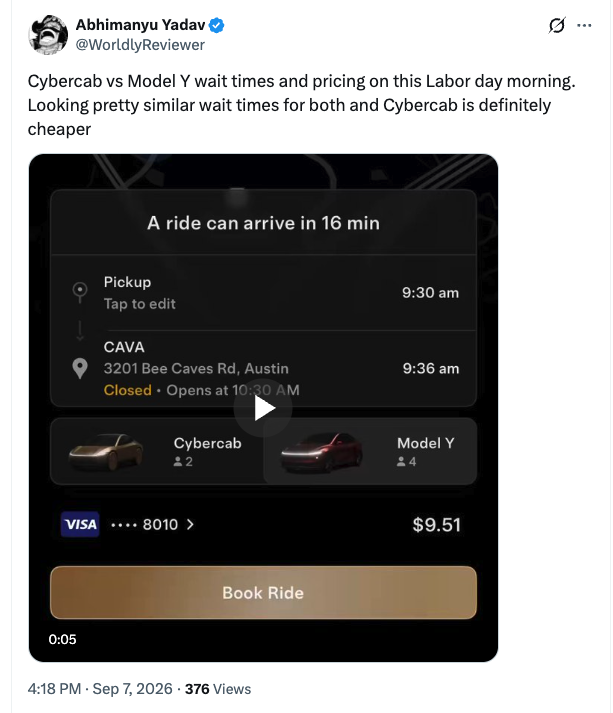
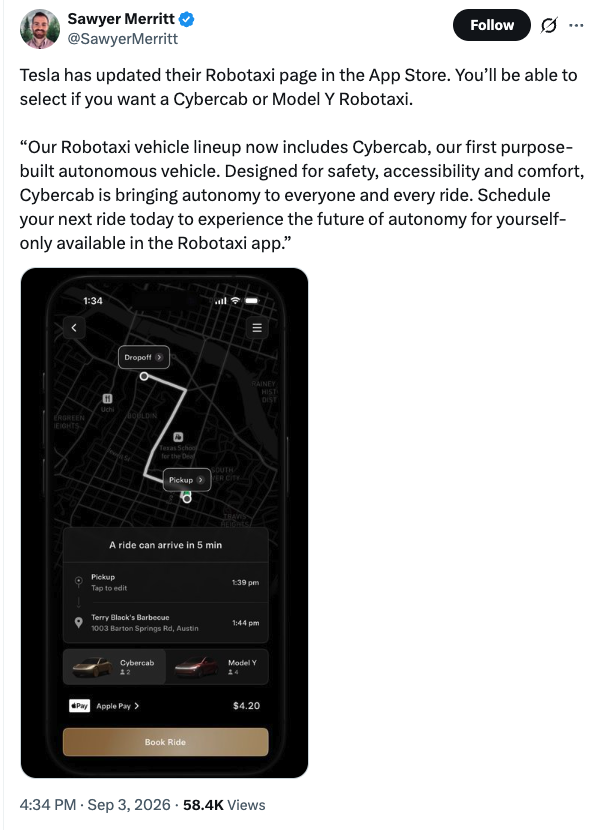
@dreev Now that actual paying customers are taking rides on the Cybercab (obviously unsupervised), what are your thoughts?
@MarkosGiannopoulos I think it's a positive update so far. I still think there's a big burden of proof on YES. It's just so hard to put lines in the sand for what should make it definitive, in either direction.
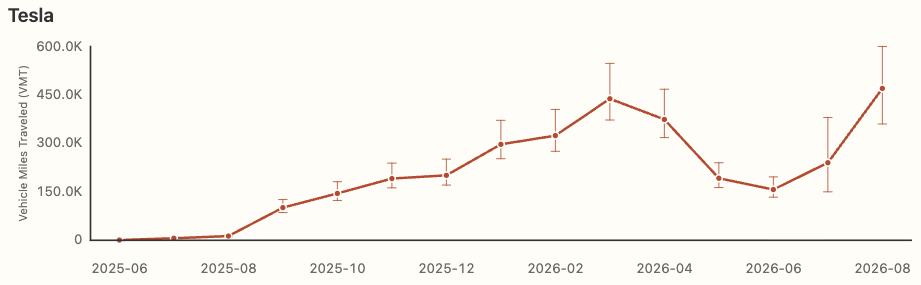
Here's another random scenario, in case this is helpful. Suppose the Cybercabs were to get Lidar sensors before the red graph of Tesla robotaxi miles becomes visible as more than a dusting along the x-axis when plotted on the same graph as Waymo:
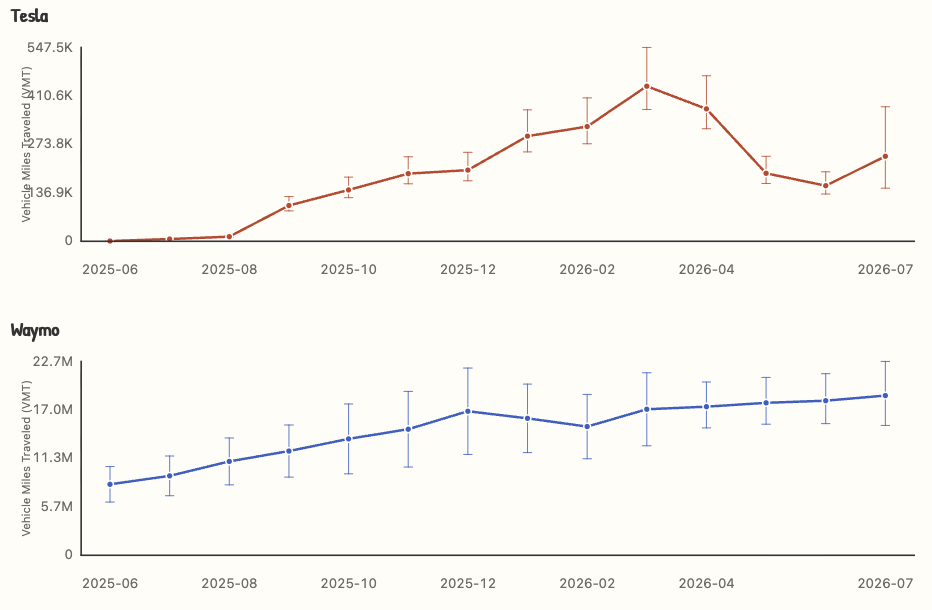
I'd call that an example of an easy NO because it would show that Tesla was running a limited pilot/demo until the tech could support level 4 autonomy.
Of course for YES we have a laundry list of hurdles. Like deciding, in retrospect, that it went without saying that Tesla never rigged the passenger-side door-open button as an emergency brake.
(Note that it's not enough for us to merely learn that there was never any such kill-switch. I have to honor my commitment to the NO bettors that lack of transparency from Tesla on that question a year after launch would default us to NO. We got transparency about tele-operation in time but maybe technically not about kill-switches. So that's one -- of maybe multiple -- by-the-letter arguments that could be made for NO. But since I'm obsessed with spirit-over-letter aka making everyone happy somehow, I want to allow for the possibility that we'll look back at the kill-switch question and feel that Tesla was perfectly transparent in the sense that it was never a credible enough accusation for them to bother refuting. I do think that's a faithful definition of transparency. So I'm not sure we have in fact violated the letter in favor of the spirit. Of course if we do have to choose between letter and spirit, that's a failure on my part in defining the resolution criteria.)
As another way to think about all this, put yourself in the shoes of a bull vs a bear when this market was created. The bear expected Tesla to miss the deadline. The bull expected the robotaxis to steadily ramp up and at least meaningfully compete with Waymo over the following year. So both were wrong and I think the future will tell us who was more wrong. If Tesla never meaningfully competes with Waymo then the bull was more wrong. If, as I've put it in other comments, Tesla ramps up decisively from here, the wiggles in the above graph end up invisible, and we're left with a smooth hockey stick and Waymo in shambles, then it will have ended up feeling like the bear was more wrong.
To name another possible by-the-letter argument for NO, the market description said from the start that we need intent to scale up. That Tesla robotaxis have to "become a thing", with summer 2025 as when it started. Obviously "become a thing" was stupidly vague (I apologize!) so ignore that. But Tesla itself now prefers to treat January 2026 -- when they started ditching the passenger-seat safety monitors -- as when it started. They prefer that, as I argued in an AGI Friday, because it lets them tell a continuous growth story. I mean, they're still trying to have it both ways, so I'm not sure this proves anything. But if Tesla ends up settling on a consistent story where summer 2025 is treated as a pre-launch trial... I guess this is yet another rationalization for continuing to keep this market open?
@dreev >"put yourself in the shoes of a bull vs a bear... Tesla ramps up decisively from here, the wiggles in the above graph end up invisible, and we're left with a smooth hockey stick and Waymo in shambles, then it will have ended up feeling like the bear was more wrong."
There are 2 sorts of bears. Bear1 thinks they will never get it working well enough and bear2 who thinks they will get there but not by the 31 Aug 2025 deadline. I would suggest bear1 is irrelevant likely to be more wrong than anyone. It is bear2 that matters for this question. So a smooth ramp up from now on does not make bear2 wrong if the start of the continuous growth is from when v15 software is brought into use. Saying bear1 is more wrong to judge the question seems unfair on bear2 (yes I consider myself to be a bear2 case). Seems to me like the test ought to be if the smooth ramp up only begins to happen after 31 Aug 2025 then it wasn't done in time and bear2 is more correct than the bull.
There was something suggesting pre release v15 was in testing by the robotaxis before the launch event, but I am not sure this was definitive or if there is any other better information on this.
Even if you don't agree about v15 being the start of the smooth ramp up, there were no unsupervised miles before ~Dec 2025/Jan 2026 so at best the smooth ramp up started then or later. Yes we can get back to arguing along the lines of v14 .2? might have been good enough but out of abundance of caution Tesla has waited on v15 before trying to get regulators to assess and accept the system is adequately safe. However the human equivalent safety also seems to point to ~Jan 2026 when it was good enough which is after the 31 Aug 2025 deadline.
Not sure I see what you need to wait for now. A graph of VMT to 1 year after 31 Aug 2025 might be nice to see but if you aren't careful you then might want to see 2 years after 31 Aug 2025 and we go on endlessly waiting.
@ChristopherRandles Agreed that we can focus on Moderate Bear who merely bet Tesla wouldn't make the deadline, not that they'd never get there. And Moderate Bull merely bet Tesla would launch on time, it would count as level 4, and it would eventually grow and compete with Waymo, not that it would necessarily destroy Waymo or that it would scale up on any particular timescale.
(It's funny how rare Moderate Bear and Moderate Bull are on the wider internet, but this market is a bastion of sanity and truth-seeking. I love it, for real.)
Good call on FSD v15. That could be a key NO argument if Tesla needed to wait till version 15 to scale up. But there's nothing about version numbers in the resolution criteria. So this argument kind of reduces to trying to infer whether Tesla's robotaxis on presumably-v14 were level-4 autonomous. That seemed implausible to me for a long time and now seems less implausible.
At some point I clarified that we're considering at-least-slightly-superhuman safety to be part of the definition of level 4 (otherwise a Yugo with a brick on the gas pedal could technically satisfy the lack-of-supervision criteria). So if the summer 2025 robotaxis were sufficiently unsupervised and sufficiently safe, should it matter if they were less safe than today's v15 cars? Should it matter if Tesla was afraid to scale up until the extra-superhumanly safe v15?
I'm genuinely so uncertain! And I realize there were a lot of big ifs in the previous paragraphs. Were they sufficiently unsupervised? In terms of tele-operation, I'm satisfied. In terms of the passenger-seat safety monitor's ability to intervene, I'm mostly satisfied (and then see the messy parenthetical above about defining "transparency"). In terms of safety, there's insufficient data so maybe we're screwed and will have to resolve-to-PROB, if nothing else resolves it. Or maybe a robotaxi or will kill someone tomorrow and we'll have our answer (mostly -- humans do that every 100 million miles so if a robotaxi does it after 3 million, that'd be quite damning, plus we'd be presuming last summer's robotaxis were even less safe than what we have now).
Basically what I'm waiting for is one of a million weird things that could happen to make this resolution an easy NO. If none of those things happen, there's still plenty of agonizing. I'm not saying that we've got a YES by default if everything goes swimmingly from here. But I guess I'm seeing a narrow path to what might feel like a YES at least in spirit?
The weakest step in that YES path right now feels like the question of whether summer 2025 was a trial/demo more than a launch.
Compare this to a hypothetical market for whether Tesla would begin autonomous deliveries of Teslas by last summer. An autonomous delivery did happen, once, on June 27, 2025, and never again. Feels like a NO in spirit, right? Even if we had failed to pin down what "begin" meant. The robotaxis feel, to me, intermediate on a spectrum between that and a legit launch that's merely ramping up slowly.
One more idea for the NO side: Tesla still hasn't applied to run robotaxis in California, with its stricter transparency requirements. It's super suspicious, especially with Musk's deceptiveness about what the holdup was in California.
PS: Just last month they did finally take a baby step in that direction, getting a permit to test AVs with a safety driver in the driver's seat.
@dreev >"The weakest step in that YES path right now feels like the question of whether summer 2025 was a trial/demo more than a launch."
I am inclined to admit I feel June 2025 was more like a launch rather than a trial/demo but the question is whether it is a launch of a level 4 system or a launch of a sub level 4 system.
You seem tied up in the minutia of whether a passenger door button was direct brake or instruction to driving system and the transparency around this. I wonder if you are not seeing the wood for the trees. Even if it is technically not a breach of level 4, the monitor by watching and being able to react even if only slowly still contributes towards safety and the presence of this monitor is a sign that the system wasn't good enough for Tesla to let it loose on its own.
Add to this the analysis of data suggesting it only became good enough around Feb 2026. This analysis may be rather vague and uncertain but what you have to ask yourself are we going to get any better analysis? Tesla isn't going to publish anything saying the system wasn't good enough, and their actions of keeping monitors until 2026 speaks volumes.
So for me the weakest/practically impossible?/impossible? step in the YES path right now is the system wasn't good enough at June 2025 (or Aug 2025). Extra evidence about whether v14.2 was good enough and we could regard launch date as Jan 2026 or whether we wait for v15 and a 3 Sept 2026 launch date might be forthcoming but it doesn't really matter if the conclusion is that the system wasn't really good enough at June 2025. There were erratic driving incidents attracting regulatory investigation and even if some improvement did occur before 31 Aug 2025 there was no further viable potential launch date until Jan 2026.
Maybe the safety analysis as to when Tesla system was good enough could be refined, but are we going to get that or is the focus going to be on latest performance?
@ChristopherRandles Yeah, here's what I get if we try to look at at-fault accidents for the first 4 months of the robotaxi program:
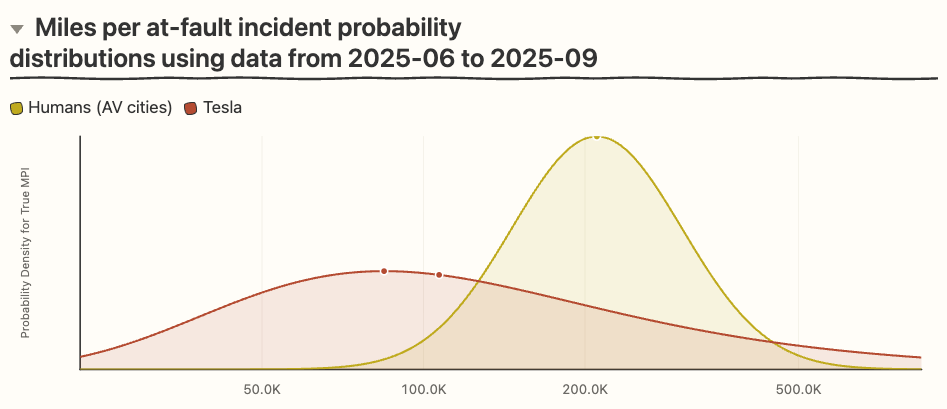
Not enough data to be sure of anything but if we had to guess we'd say subhumanly safe. For more recent robotaxi mileage, starting January 2026, it flips:
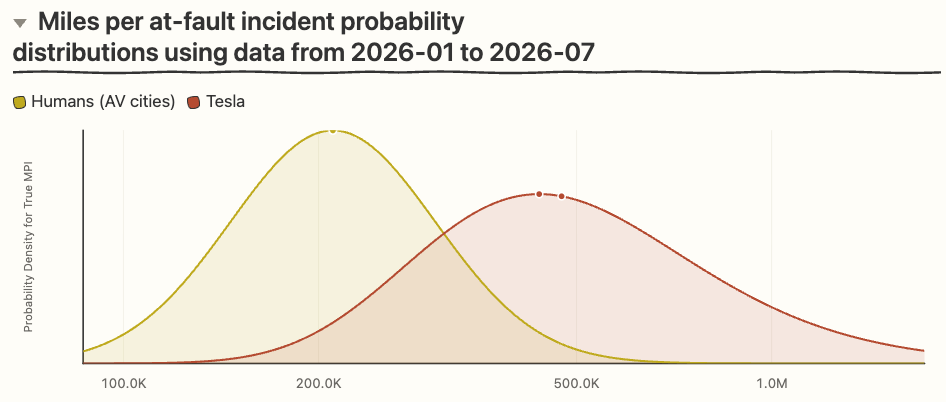
What do people think? Would you rather resolve now even if that means resolve-to-PROB or keep waiting in hopes of getting a clean NO? (I'm also not convinced that the YES path is impossible, just that it won't be clean.)
@dreev That is the average over the 4 months, right. However we are aware of erratic driving at the start of public rides in June 2025. I presume they put some fixes or workarounds in fairly fast as reporting of such erratic driving seemed to become much less common after the first week or two. Using the probability of Tesla being above human over those 4 months would seem to overestimate the probability at the launch date due to improvements over the period. So how would you calculate a probability to resolve this market?
If there are other chances of a full no resolution then no holders should prefer to wait?
@ChristopherRandles I personally prefer to wait, because I'm holding out hope that the ambiguity resolves itself and the answer ends up clear, or at least clearer, with more hindsight.
Here's my tool for playing with different ways to define safety, date range, and human comparison baselines:
https://teslapologetics.dreev.es/?f=All&s=-&a=1&c=HumansAV.Tesla&m=atfault&x=vmt.mpi&v=1
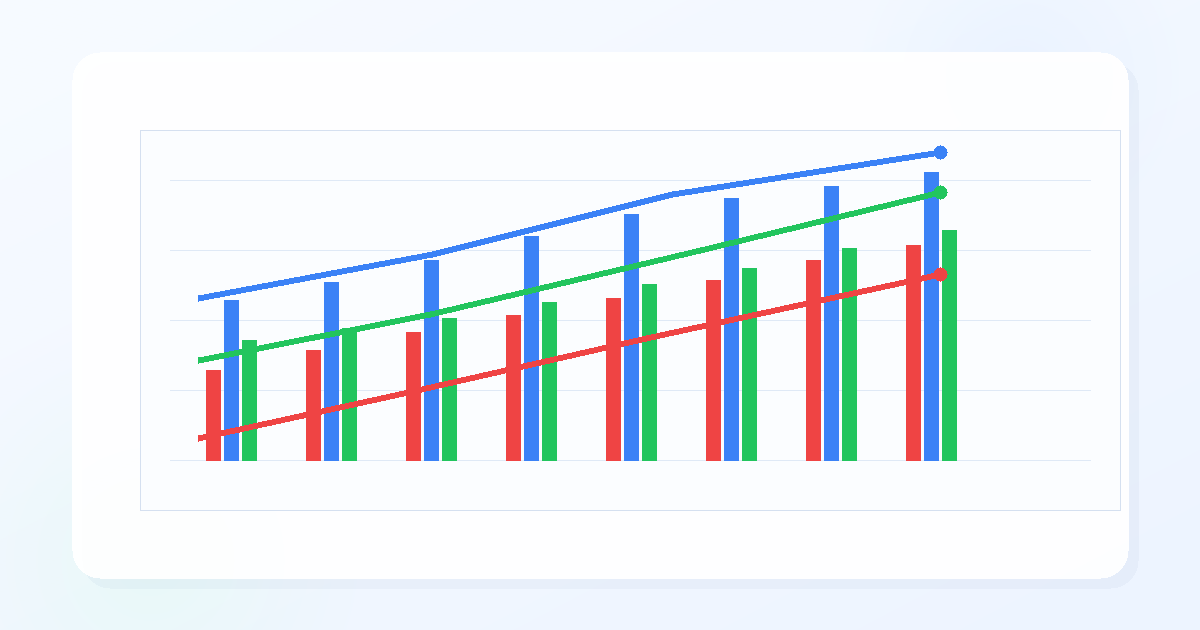
One approach for resolve-to-PROB could include picking parameters and then computing, according to that model, the probability that Tesla was as safe or safer than humans on August 31, 2025. I shudder at the idea of doing this since there are an insane number of pretty arbitrary modeling assumptions that go into that. And Tesla probably does have the FSD data internally to answer it definitively.
@100Anonymous If I literally changed something that would be bad. My stance is that it's brutally ambiguous whether what happened in summer 2025 counted and that we'll be able to judge it more fairly with more hindsight.
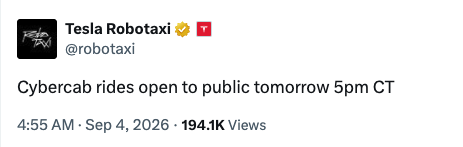
Sawyer Merritt (@SawyerMerritt) on X
BREAKING: Tesla has officially started offering Cybercab rides to the public. I’ve been waiting years to say that! I took one of the world's first public rides. The cabin is comfortable and spacious, the suspension is soft, and FSD is VERY smooth. It’s an incredible vehicle. The screen is HUGE. The video doesn’t do it justice. We can ride in the Cybercab anywhere in Tesla’s Austin service area, so the same areas as the Model Y Robotaxi. The Cybercab lives up to the hype. It will transform travel.
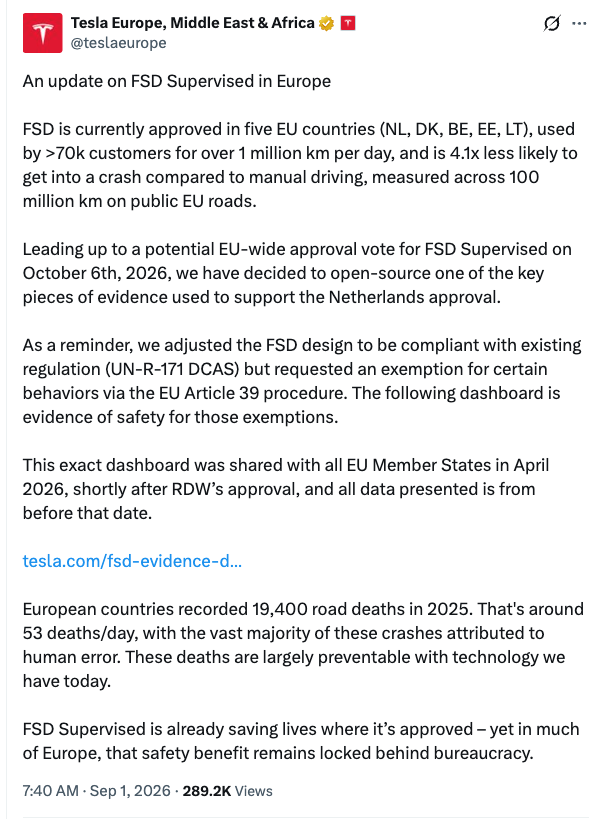
Tesla claim: 4.1x less likely to get into a crash compared to manual driving, measured across 100 million km on public EU roads.
@MarkosGiannopoulos I think data like this could be persuasive if it showed FSD to be safer than humans even when pessimistically treating every (non-parking-lot?) disengagement as a would-be crash.
Without doing that, all we've proven is that centaur driving beats human driving.
In reality, I think humans using FSD get so complacent that the supervision adds very little safety, but that's speculation not proof.
The other problem is that Tesla has a history of lying and cheating when presenting this kind of data, though perhaps this data exhibits a new level of transparency?
@dreev Well, the Netherlands authorities tested FSD and Tesla's records for 18 months and allowed it in the country (kicking off similar decisions from several other countries)