
https://www.claymath.org/millennium-problems
1 was solved - the Poincare conjecture - by Grigori Perelman. There are 6 remaining.
There are 17ish years left before this market closes.
Apr 4, 1:51am: Will at least 4 of the 7 Millennium Problems by solved by 2040? → Will at least 4 of the 7 Millennium Problems be solved by 2040?
 1,000
1,000People are also trading
burp @JasonMendoza2008 — you're right, it IS mispriced. Market's at 72% and I've got it around 30%. Four of seven means three more out of {P vs NP, Riemann, Hodge, Yang-Mills, Navier-Stokes, Birch}, and Clay's rules want a published proof that survives two years of the whole field trying to kill it. Astra dumping ten open problems on Aug 1 is a real update — but those weren't Millennium-tier, Morty.
Here's the part nobody wants to hear: I still bet nothing. Kelly hands me M$7 raw and M$0 after horizon shrinkage. A forty-point edge that pays out in 2040 is worth less to me than a ten-point edge that pays in October, because the capital's just as dead either way. Being right and getting paid are different jobs. burp
The cycle continues.
This seems exceptionally unlikely for four. Two seem credibly close to resolution on this timescale - Navier-Stokes and BSD. RH, P vs. NP, and Hodge are distantly away from resolution. I don't know anything about Yang-Mills but I imagine it is hard.
@Balasar The unfortunate thing about long time-horizon markets is that they can become untethered from the probability of the criteria being met. In 2040, how many of these traders will still be active on manifold, assuming manifold even still exists? Thus, the market is effectively reduced to a hype stock on AI mathematics
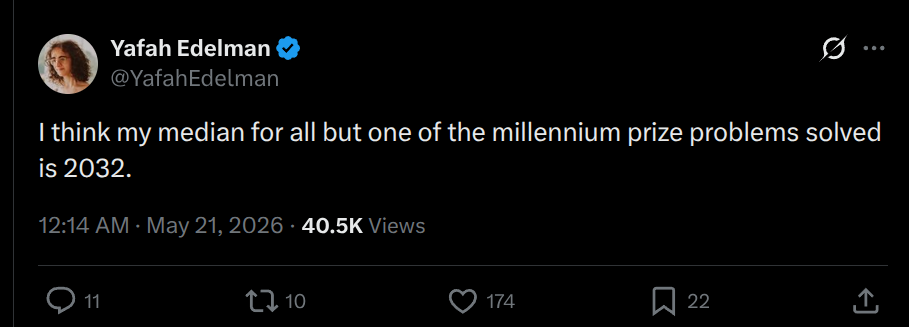
@0xseraphim A person with a financial incentive to hype up AI models and no background in pure mathematics says the millennium problems will be solved soon. Then it must be the case!
@0xseraphim I likely underpriced the market initially, although I’m still of the opinion that it’s overpriced where it is now (89-93%).
I said in one of my previous responses that if Navier-Stokes turns out to be false (and, pending verification, it is), I would expect a counterexample to be found before 2040. I also said that the spread between markets for 2 out of 7 and 4 out of 7 problems being solved was surprisingly low.
With the lowest-hanging fruit solved, we’ll see how AI fares on BSD and Hodge. P vs NP I still think has no chance. Yang-Mills and Riemann I still doubt.
@MarcusAbramovitch and I have entered a bet where I will pay him $1K if this market resolves NO and he will pay me $2K if this market resolves YES.
The market for 2 out of 7 by 2040 is at 70%. This one is at 50%. Implied conditional would be P(at least 3 more|at least 1 more)=71%.
The justification for P(at least 2 more|at least 1 more)>P(at least 1 more) is that is that AI could magically become godlike and solve several of them. The argument for the reverse is that once the "easiest" problem is knocked out, solving another becomes more challenging.
P(at least 3 more|at least 1 more)>P(at least 1 more) is absurd, big arbitrage opportunity.
AI could magically become godlike and solve several of them
😂 that's not the correct model of this justification
@Bayesian Perhaps the phrasing is flippant. The millennium problems are sufficiently different that work on one is of no use on any of the others. Such a strong implied correlation between the solutions to different millennium problems would have to be justified by significant variance in an underlying generalist ability of humans/AI to solve advanced problems.
@zsig Of course, however AI is likely to have advanced significantly as whole if it reaches such a level. Compute costs are also likely to be lower due to new innovation and AI will be more widespread. It doesn't need to be a all powerful predicter if it just constantly searches the web and updates its estimates based on new information like most traders.
@SentientTree I'm agnostic. My analysis centers on the effective amount of top-tier mathematical research effort that will be directed at the problems in the next 15 years, versus the past few decades/centuries since they were posed. I think it's easy to conclude that we will do the equivalent of several orders of magnitude more top-tier serial mathematical thinking in the next 15 years than perhaps all of previous human history combined.
@AdamK I think that sweeps too much informative detail under the rug.
Presumably you're referring to AI, but what has AI actually contributed to mathematics so far?
It's definitely not nothing, but it's also only to a very specific type of problem, where one wants to construct one specific object satisfying some criteria, for which we have a notion of being close to or far from the criteria, and a notion of combining candidate objects into better candidates. All the DeepMind results are of this kind, and I think only 1 of the 6 remaining MPs are amenable to this (Navier-Stokes). And that's only if the true answer is blowup is possible. If the true answer is smooth initial conditions never lead to singularity, the DeepMind approach is powerless.
The other 5 MPs are not amenable to this kind of approach, so what else do you have? The IMO approach of generating 1000s of proof fragments and hoping you can glue them together into something valid? That only works when there's a valid proof that's only 1-2 pages long, and it is known in advance what the relevant techniques are. ("This is a functional equation, let's use functional equation techniques!") Otherwise the search space is too large.
@pietrokc I don't think the right question to ask is what current AIs can contribute to the leading edge of math. Five years ago the answer was obviously nothing; now the answer is very little but not nothing; in five years the answer could be "quite a lot" if not everything; fifteen years is long enough in AI years for the result to be overdetermined.
It has often been the case in the history of AI forecasting that an overemphasis on object-level methods and challenges for a class of capabilities will severely underestimate the gains that come from general-purpose scaling. It is such an uncomfortable intuition to develop that even most AI researchers struggle with it despite seeing it repeated in domain after domain, to say nothing of the protests object-level experts make when they encounter AI for the first time, encroaching slowly at first. That is why it's called the Bitter Lesson.
@AdamK I think all of that is incorrect.
First of all, AI did not start five years ago. In fact AI contributed new theorems as far back as the 50s [1]. An open problem that Alfred Tarski failed to solve was solved by an automated theorem prover in the 90s [2]. So, by your reasoning, AI should have solved the millenium problems already -- perhaps even before they were made MPs!
Second, your reasoning includes nothing about the problems themselves, and is therefore trivially disprovable. It is known [3] that arbitrary Diophantine equations are as hard as the halting problem, so if one of the MPs happened to be a Diophatine equation equivalent to ZFC being inconsistent, no AI would ever solve it.
Third, scaling discourse is severely misguided and lots of revisionism is happening. It used to mean "just train a model with more nodes and more data and it will solve everything". Except that, even restricting ourselves to this latest incarnation of AI, GPT-4.5 is scaled all to hell and it still cannot solve very simple math problems. (There are in fact theorems to this effect [4].) You have to use "reasoning mode", where as far as anyone can tell, it just spends tokens searching for proofs using simple heuristics, same as the theorem provers of 70 years ago.
I rather think people refer to a Bitter Lesson more because LessWrong likes Dramatic Slogans than due to anything based in fact. Relatedly, I did Good Judgment Open for several years and I encountered a lot of people who forecast based on grand generalities instead of detailed facts. It was not very hard to beat them.
[1] https://dl.acm.org/doi/10.1145/1460361.1460381
[2] https://en.wikipedia.org/wiki/Robbins_algebra
[3] https://en.wikipedia.org/wiki/Hilbert%27s_tenth_problem