Ben Hylak has made a handful of predictions related to a question for which I have another market linked below.
This resolves YES if Ben Hylak is right.
https://x.com/benhylak/status/1936926061348134983
https://x.com/benhylak/status/1936950420854972810
I.e., this resolves YES if by 2026 either one of:
A Tesla Robotaxi is involved in an accident for which Tesla is at-fault
We learn that Tesla Robotaxis have an intervention rate similar to Cruise, which seems to have been reported as being close to 2-4% of the time, and at a frequency of about every 2.5-5 miles
 1,000
1,000People are also trading
https://robotaxitracker.com/nhtsa?provider=tesla&area=austin
Shows 7 accidents as "Tesla at fault". 2 of these were when teleoperators were in control. Remaining 5 were dated:
Sept 2025
October 2025
and 3 in January 2026
So there is 2 accidents before 2026
Sept 2025
The Tesla ADS was stopped in the bi-directional turn lane (or center left turn lane) of a five lane road with its left indicator active. When the two lanes of oncoming traffic were clear, the ADS made an unprotected left turn into an entrance of a parking lot. As the ADS entered the parking lot, the ADS made contact with a metal chain. The ADS had a safety monitor present with one passenger in the vehicle.
Oct 2025
The Tesla ADS made a left turn onto a residential street. As the ADS passed a residential house, with a dump trailer parked in the driveway and the trailer's gooseneck hitch sticking out into the street, the ADS's side mirror made contact with the gooseneck hitch. Safety monitor was present and no passengers were inside the vehicle.
@AffineTyped
Is that sufficient for a yes resolution and if not what else would be needed?
Daniel Reeves wrote at https://manifold.markets/dreev/will-tesla-count-as-a-waymo-competi
quoted below
This seems like 2 100% Tesla fault accidents. 8mph and 6mph so not really serious.
Also fully without safety monitors only started 22 Jan and maybe ~27th Jan before no chase car.
HTH
[quote:]
I went to the primary source on this and learned things:
Tesla reported 9 robotaxi incidents in the period for which NHTSA provides data (2025 Jun 16 to Dec 15)
For 4 of those, the robotaxi was going 2mph or less
Only 1 involved injuries (minor)
Here are what I believe to be the most complete characterizations of the incidents we can get from the NHTSA data:
July, daytime, an SUV's front right side contacted the robotaxi's rear right side with the robotaxi going 2mph while both cars were making a right turn in an intersection; property damage, no injuries
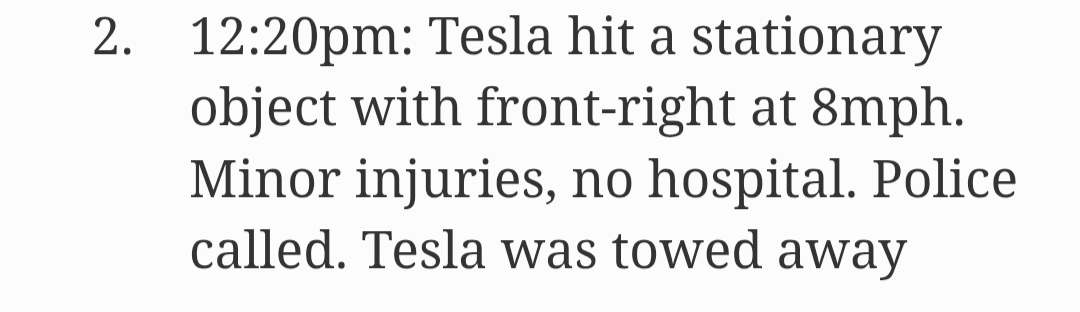
July, daytime, robotaxi hit a fixed object with its front right side on a normal street at 8mph; had to be towed and passenger had minor injuries, no hospitalization
July, nighttime, in a construction zone, an SUV going straight had its front right side contact the stationary robotaxi's rear right side; property damage, no injuries
September, nighttime, a robotaxi making a left turn in a parking lot at 6mph hit a fixed object with the front ride side of the car, no injuries
September, nighttime, a passenger car backing up in an intersection had its rear right side contact the right side of a robotaxi, with the robotaxi going straight at 6mph; no injuries
September, nighttime, a cyclist traveling alongside the roadway contacted the right side of a stopped robotaxi; property damage, no injuries
September, daytime, a stopped robotaxi traveling 27mph [sic!] hit an animal with the robotaxi's front left side, no injuries [presumably "stopped" is a data entry error]
October, nighttime, the front right side of an unknown entity contacted the robotaxi's right side with the robotaxi traveling 18mph under unusual roadway conditions; no injuries
November, nighttime, front right of an unknown entity contacted the rear left and rear right of a stopped robotaxi; no injuries
All the other details are redacted. I guess Tesla feel like they have a lot to hide? The law allows them to redact details by calling them "confidential business information" and they're the only company doing that, out of roughly 10 of them. Typically the details are things like this from Avride:
Our car was stopped at the intersection of [XXX] and [XXX], behind a red Ford Fusion. The Fusion suddenly reversed, struck our front bumper, and then left the scene in a hit-and-run.
I.e., explaining why it totally wasn't their fault, with only things that could conceivably be confidential, like the exact location, redacted. So I don't think Tesla deserves the benefit of the doubt here but if I try to give it anyway, here are my guesses on severity and fault:
Minor fender bender, 30% Tesla's fault (2mph)
Egregious fender bender, 100% Tesla's fault (8mph)
Fender bender, 0% Tesla's fault (0mph)
Minor fender bender, 100% Tesla's fault (6mph)
Minor fender bender, 20% Tesla's fault (6mph)
Fender bender, 10% Tesla's fault (0mph)
Sad or dead animal, 30% Tesla's fault (27mph)
Fender bender, 50% Tesla's fault (18mph)
Fender bender, 5% Tesla's fault (0mph)
Those guesses, especially the fault percents, are pulled out of my butt. Except the collisions with stationary objects, which are necessarily 100% Tesla's fault. But if we run with those guesses, that's 3.45 at-fault accidents. Over how many miles? More guessing required! I believe that for a while, all Tesla robotaxi rides had an empty driver's seat. But starting in September, Tesla added back driver's-seat safety drivers for rides involving highways. Or more than just those? We have no idea. We do know of cases of Tesla putting the safety driver back when the weather was questionable. In any case, only accidents without a safety driver in the driver's seat are included in this dataset, so we do need to subtract those miles when estimating Tesla's incident rate.
Tesla is reporting to the NHTSS that their robotaxis were involved in 3 accidents in July. While Tesla is redacting the narrative description of the accident, in one of them they were the only car so I think you have to conclude this was their fault.
The data Tesla reported can be found in the link below.
https://static.nhtsa.gov/odi/ffdd/sgo-2021-01/SGO-2021-01_Incident_Reports_ADS.csv
@WrongoPhD I'm super busy currently and don't have a lot of time to follow the approximate argument being made here. If it can be made a bit more clear to me step by step, or if a top YES trader signs off on it I'll be more likely to resolve YES expediently.
Good reporting coming to the conclusion would work too.
Otherwise, I'll take a look sometime in the next week.
@AffineTyped https://www.forbes.com/sites/bradtempleton/2025/09/18/tesla-robotaxi-reports-3-crashes-in-austin-on-july-1-details-hidden/
Tesla is clearly to blame for this accident since there were no other cars involved other than the Tesla.
There were two other crashes as well, but not enough information to assign blame on those accidents.
I knew Cruise had a high intervention rate, but didn't actually read about it until today.
They admitted to the car calling a remote operator every 2.5-5 miles but "Of those, many are resolved by the AV itself before the human even looks at things, since we often have the AV initiate proactively and before it is certain it will need help. Many sessions are quick confirmation requests (it is ok to proceed?) that are resolved in seconds."
To me, this still sounds more advanced than Tesla's current robotaxi, which essentially has a permanent monitor in the car to constantly answer the question: "is this okay?"