Resolves upon publication of the 2025 DHS Yearbook of Immigration Statistics, or earlier if official DHS data is available that can reasonably be expected to contain identical data to what will be in the Yearbook:
https://ohss.dhs.gov/topics/immigration/yearbook
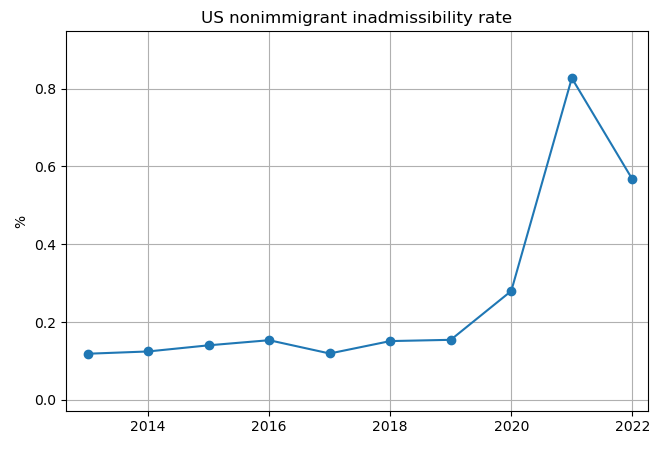
The US nonimmigrant inadmissibility rate for the purposes of this market is defined as:rate = inadmissible / (admissions + inadmissible)
If this rate is at least three times as high in 2025 as it was in 2024, the market resolves YES. Otherwise it resolves NO. Both the 2025 and 2024 rates will be calculated from data published in the 2025 yearbook, disregarding any data in the 2024 yearbook.
As an example, in the 2022 yearbook of immigration statistics:
https://ohss.dhs.gov/sites/default/files/2024-03/2023_0818_plcy_yearbook_immigration_statistics_fy2022.pdf
Total nonimmigrant admissions (Table 25, page 65):
2021: 35,300,000
2022: 96,800,000
Inadmissibility determinations are (Table 37, page 98):
2021: 294,351
2022: 551,928
Therefore the inadmissibility rate is:
2021: 0.83%
2022: 0.57%
Potentially more timely publication of some of the same data can be found here:
https://ohss.dhs.gov/topics/immigration
Though I'm yet to see a data table other than that in the Yearbook that includes all nonimmigrant admissions, and not only I-94 admissions.
 1,000
1,000People are also trading
Doing some vibe math:
Resolution. The creator defines, for each fiscal year, rate = inadmissible / (admissions + inadmissible). YES requires the FY2025 rate to be at least three times the FY2024 rate. Both years must be calculated from the eventual 2025 DHS Yearbook of Immigration Statistics, disregarding the 2024 yearbook; earlier official DHS tables may be used only if they can reasonably be expected to contain identical data. The description points to the yearbook and explains that “admissions” means all nonimmigrant admissions, not merely I-94 admissions. The creator's April 2025 comments expressly rejected the narrower annual-flow denominator, added the early-resolution allowance, and extended close to year-end 2026 with an intent to extend again if necessary. When asked what happens if the data cease to exist, the creator agreed it would “have to be” N/A.
This rule is precise mathematically but has publication and comparability risk. DHS revisions between annual files and the 2025 yearbook control; CBP's operational “OFO Title 8 inadmissibles” must ultimately match the yearbook's inadmissibility series; and the 2025 yearbook was not posted by the research cutoff. The comments imply cancellation if no adequate data ever appear, but no waiting deadline is fixed.
Evidence and updates. The available official figures make YES extraordinarily unlikely. DHS's June 2026 FY2024 nonimmigrant workbook reports 147.2 million total admissions. CBP's finalized nationwide encounter file reports 1,343,823 FY2024 OFO inadmissibles and only 437,723 in FY2025. The FY2024 rate on those figures is:
1,343,823 / (147,200,000 + 1,343,823) = 0.9047%.
Thus YES requires a FY2025 rate of at least 2.7140%. With the finalized 437,723 numerator, total FY2025 nonimmigrant admissions would have to be no more than approximately 15.69 million. That is not remotely compatible with observed travel. The Commerce Department's April 2026 NTTO forecast document records 68.288 million actual international visitors in calendar 2025, already more than four times that break-even denominator and narrower than the yearbook's all-admissions event count. CBP's inbound traveler dataset also records 143.9 million air and 236.2 million land traveler processings in FY2025; it includes citizens and is not itself the denominator, but corroborates that border throughput did not collapse to a tenth of FY2024 nonimmigrant admissions.
The numerator moved in the opposite direction needed for YES: FY2025 inadmissibles fell 67.4%. Even using the conservative 68.288 million visitor count as a proxy denominator gives about 0.637%, only 0.70 times—not three times—the FY2024 rate. The exact 2025 yearbook denominator will change that illustration, but it cannot plausibly bridge the enormous gap.
@chrisjbillington just to confirm, this needs to wait for the actual yearbook to release, the relevant data tables, are not enough, right?
"We release data tables as they become available. We release the final yearbook PDF in September of the following fiscal year. "
But the 2023 Yearbook on that page still says "Download coming soon"
@DanielTilkin Ah! If the exact same data is available earlier, yes, I see no reason not to use it. I'll verify this and update the description if so.
@DanielTilkin Hm, I'm seeing that the Nonimmigrant Admissions Annual Flow Report only covers I-94 admissions, and not e.g. visa waiver program, most Canadian tourists (though this may change), etc. So that's not comprehensive compared to what's in the Yearbook.
And it looks like the 2023 Immigration Enforcement Actions Annual Flow Report (for inadmissibility numbers) isn't out yet either.
Nonetheless updating the description to say that early resolution is possible if data is available that can reasonably be expected to be identical to what will be in the Yearbook.
@chrisjbillington If it takes that long for the data to come out, you probably want to extend the closing date, otherwise you'd be locking up mana for a long time.
@DanielTilkin Oh, I could have sworn I picked a close date based on expected publication timeframe. In any case, extended until EOY 2026, and I intend to extend the close date further it needed.