
Recent polling suggests that the decline in religious affiliation in the US has stagnated. Will that trend reverse in the coming years? Resolves based on:
Poll: Gallup--What is your religious preference — are you Protestant, Roman Catholic, Mormon, Jewish, Muslim, another religion or no religion? (see https://news.gallup.com/poll/1690/religion.aspx)
Criteria: If the average Christian affiliation from 2026 through 2031, rounded to the nearest whole number, is larger than the average Christian affiliation from 2021 through 2025, then the market resolves YES. Otherwise, it resolves NO. The average from 2021 - 2025 is 66%.
Christian affiliation: The sum of the Protestant, Christian (nonspecific), and Catholic categories.
-All Nicene Christian groups, those that hold to the Nicene creed, are included, so if Gallup adds another category in the future (e.g., Eastern Orthodoxy, Oriental Orthodoxy, etc.), they will be counted. Non-Nicene groups, like Mormons, are not counted.
Resolution occurs after the final polling data (from 2030) is published by Gallup. Resolves N/A if the poll is discontinued or at least one year is skipped.
 1,000
1,000People are also trading
I should note that this scenario has not occurred since the 1950s. The 1948-52 average of 91% was 3% lower than the 1953-57 average of 94%. 94% is the peak for the entire history of the survey (in terms of five year averages), and that figure has been in steady decline since the late 60s. An increase in the next five year average would be quite interesting, possibly signaling a broader societal change (e.g., in demographics or values).
This isn't specifically over the next 5 years, but this lecture by Eric Kaufmann is worth listening to. He predicts that religious fundamentalists will demographically dominate the future due to their high fertility rates.
@AdamSpence didn’t watch the video, but I disagree with the premise. Christian fertility rates are higher but not high enough to make a big dent in demographics like it is with Orthodox Jews in Israel.
Mainstream Christians do not tend to isolate from society like the Amish or Ultra-Orthodox Jews do, and as a result even those who grow up with religious parents get absorbed into the secular fold at pretty high rates.
The Christian fertility hypothesis also seems to straightforwardly fail in countries like Sweden where only 15% claim to believe in Jesus.
https://en.wikipedia.org/wiki/Irreligion_in_Sweden Just by observing countries that have started the secularism process ahead of us, it’s clear that the process ends in the death of religion. The hypothesized fertility u-shape has never happened before in the context of Christianity.
"The hypothesized fertility u-shape has never happened before in the context of Christianity."
The modern environment leading to current low fertility is EXTREMELY new in evolutionary terms. Natural selection has not had sufficient time to adapt the gene pool to maximize inclusive genetic fitness in the current environment. Unless populations are somehow immune to natural selection now, a reversion back to higher fertility mathematically has to happen. Unless LEV happens, populations with sub-replacement fertility cannot sustain themselves by definition.
I found this study on what evolutionary selection pressures are occurring in the current population. The traits that are selected against the most are cognitive ability and educational attainment. ADHD is the single strongest predictor of fertility. If exposure to and openness to new information causes people to reproduce less, this seems to be leading to a population that is increasingly genetically resistant to internalizing information.
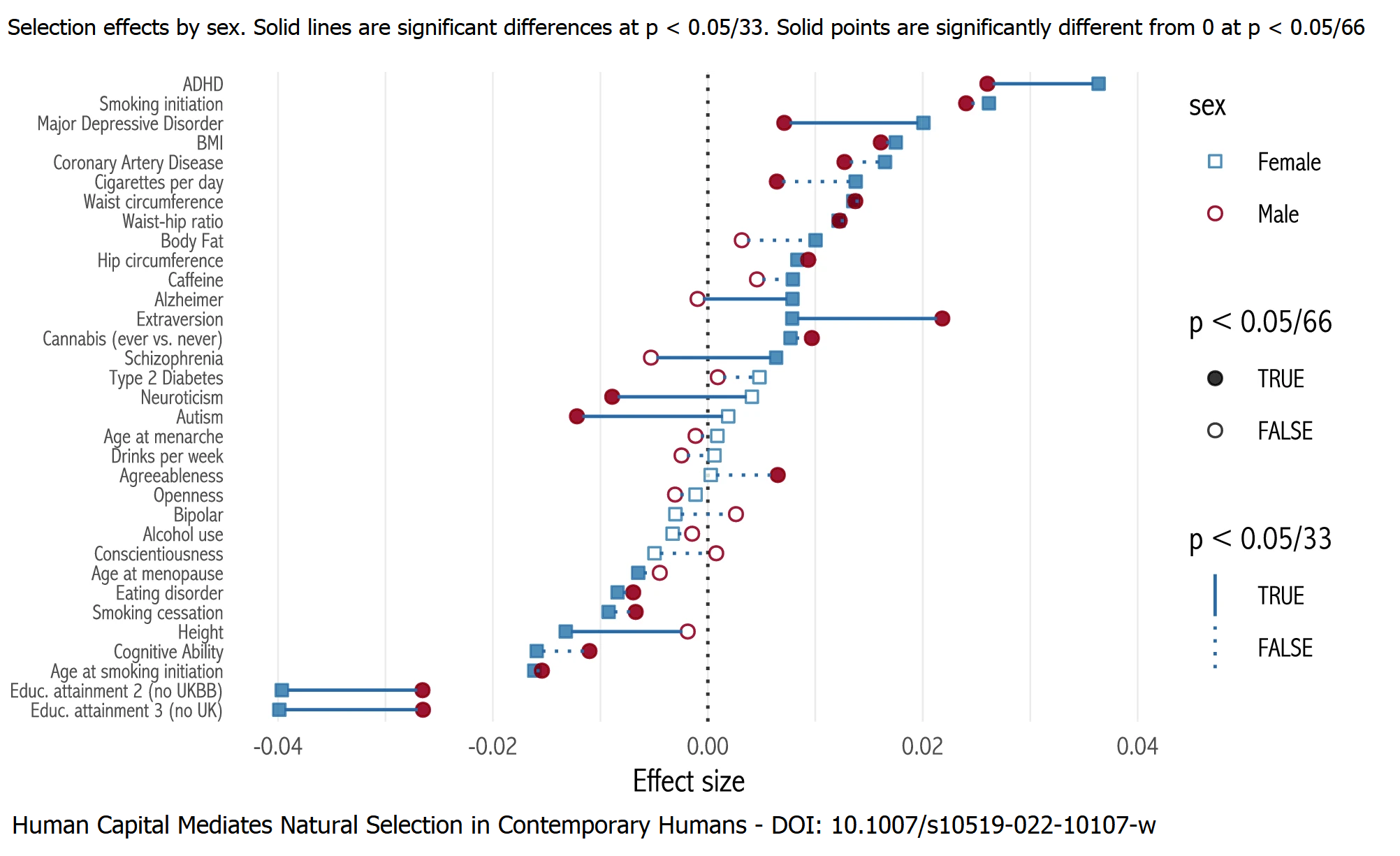
@AdamSpence Christianity is declining quickly, evolution is slow. Even if fertility is selecting for low openness and intelligence I think Christianity will have declined to near irrelevance in the developed world by the time it has happened enough to make a big difference. The effect sizes in your chart are really small.
At that point, the genetically resistant to information population will have chosen some different spiritual ideology to latch on if any at all.
"Christianity is declining quickly, evolution is slow."
Creating completely novel adaptations on par with an eye or a limb is extremely slow, but evolution absolutely can shift a population by a standard deviation for some characteristic in the span of a few centuries. Selective breeding has shown that this can happen in a fairly short amount of time, as shown with the domestication of the silver fox and factory farmed animals. There have also been observed speciation events such as the London Underground Mosquito evolving within the last few centuries as a direct result of modern society.
"even if fertility is selecting for low openness and intelligence I think Christianity will have declined to near irrelevance in the developed world by the time it has happened enough to make a big difference."
Insular religious populations with high fertility like the Amish and Hutterites are undergoing exponential growth. There will be 7 million Amish by 2100. Even if you take defection rates into account, their populations will still grow exponentially if the number of children per family on average who stay in the community is more than 2. Eric Kaufmann also discusses in the lecture how these religious societies set up parallel institutions and strict social boundaries that limit defection rates in insular religious groups.
"The effect sizes in your chart are really small."
True, but if this continues for many generations, this effect will magnify.
"At that point, the genetically resistant to information population will have chosen some different spiritual ideology to latch on if any at all."
Possibly, but whatever alternative spiritual ideology they latch onto will be one that promotes high fertility.
@AdamSpence i don’t think Christianity even has a few centuries left in the developed world. Look at how quickly it is declining in Europe. IMO, the reason it is surviving more in America is because our Baptist and Nondenominational traditions are less dogmatic and more agile in changing times.
But even that has a limit. Once you reach a threshold where like 80%+ are essentially atheists it’ll be really hard for the few Christians that are left to maintain their religiosity when surrounded by secular culture.
I think the main way Christianity could survive is if it combined itself with more plausible metaphysical teachings and more relevant morality, maybe in the form of some kind of new revelation or religious movement. A lot of people would be interested in church if God had insights about ultra-processed food, social media algorithms, AI, and climate change. But of course, then it would hardly be Christianity.