This market resolves when reliable sources aligned with global health and charities report that PEPFAR-funded organizations are once again receiving aid money, for at least 50% of their previous budget.
See also: https://manifold.markets/TiredCliche/will-pepfar-funding-be-unfrozen-by
Update 2025-03-15 (PST) (AI summary of creator comment):
Funding Source: The aid money must come from the US government.
Source Flexibility: It does not require funding to be sourced exclusively from USAID.
Update 2025-03-16 (PST) (AI summary of creator comment):
Calculation Method Clarification:
Aggregate Funding: Sum all the money sent to PEPFAR programs rather than evaluating funding on a per-charity or sub-program basis.
Threshold Requirement: The aggregate total must be at least 50% of the previous budget.
Program Adjustments: Cancellation or changes to smaller sub-programs do not automatically count against the criteria as long as the overall funding meets the threshold.
 1,000
1,000🏅 Top traders
| # | Trader | Total profit |
|---|---|---|
| 1 | Ṁ364 | |
| 2 | Ṁ329 | |
| 3 | Ṁ289 | |
| 4 | Ṁ183 | |
| 5 | Ṁ167 |
@traders Guys, I think I need help resolving this market. I thought before that it resolved "After 2025 or not at all" based on the freeze and depth of the cuts.
But I think there's a lot of evidence that both 1. funding has been approved for >50% of the previous total and 2. it has been flowing.
Take this in depth article from Sept:
"About 65 percent of USAID’s PEPFAR awards have been reported terminated, accounting for 24 percent of planned funding."
"In South Africa, terminated awards accounted for more than 75 percent of the total."
But also, "in South Africa, the country with the largest absolute number of people receiving treatment under PEPFAR awards that have been cancelled, the government has pledged additional funding to maintain treatment provision."
In other words, only 24% of the funding was cancelled originally, and some of that was further filled by additional grants to South Africa.
But is the approved funding flowing? Are people being treated?
This report on HIV shows some disruption, but not approaching 50% levels, and only in Q2, which may have been more affected from the funding freeze starting in February.
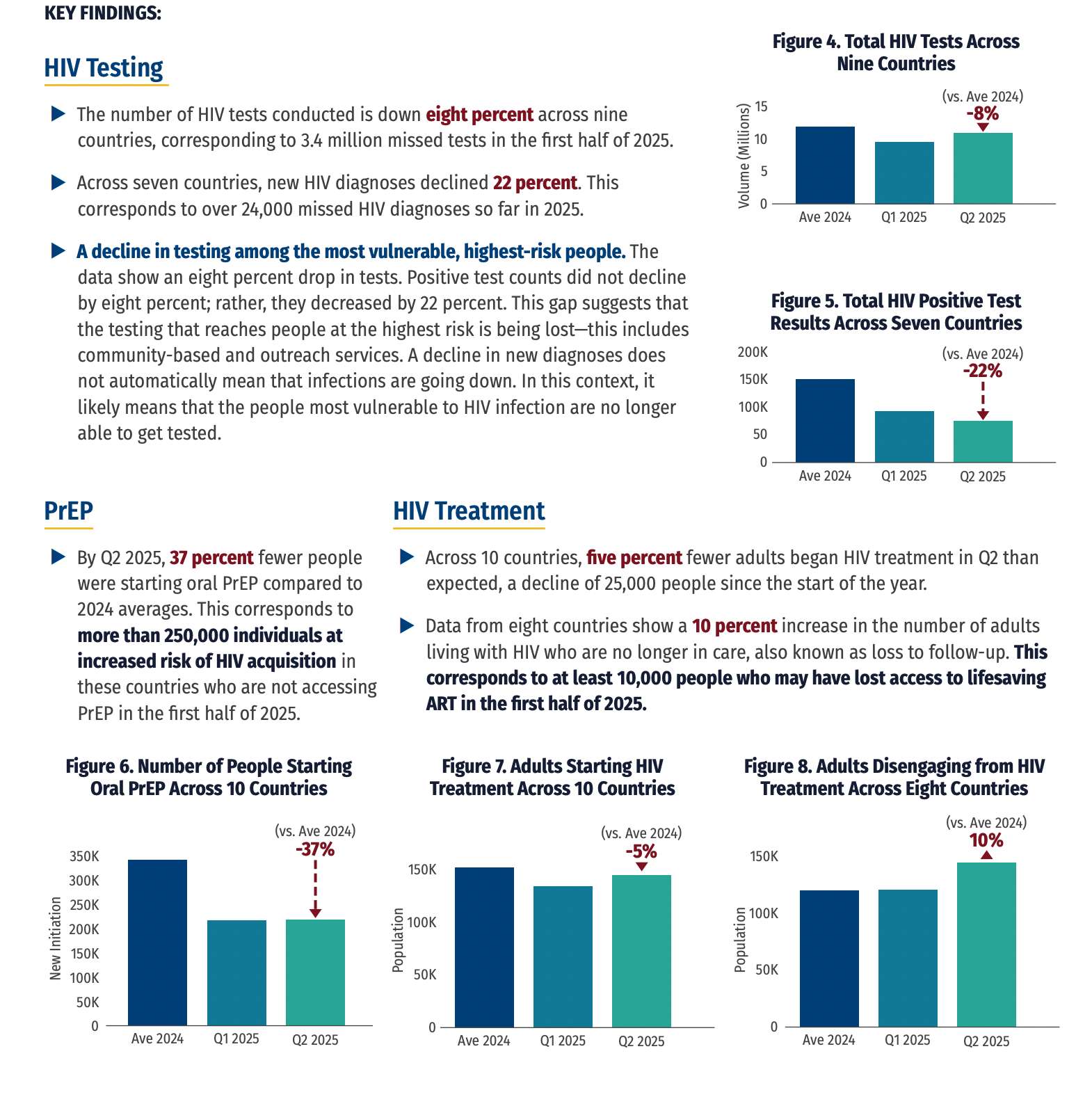
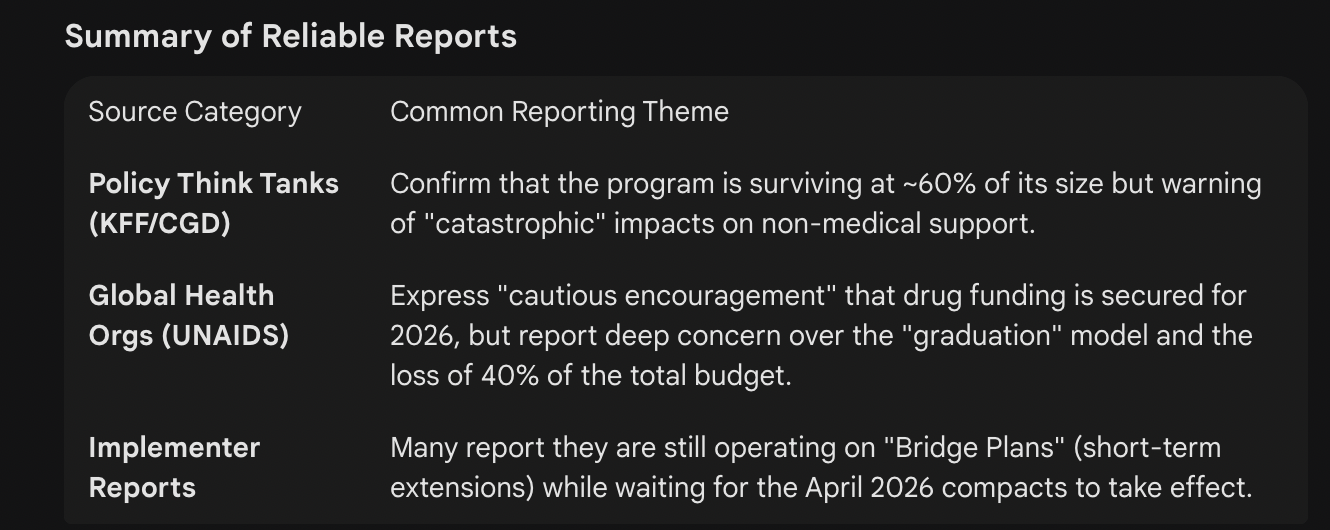
Gemini says the non-frontline medical programs got decimated, but funding is flowing otherwise at ~60% size.
Ok, so if funding was restored this year, when was that, exactly? The question also requires that the funding be actually received rather than just appropriated.
Gemini says:
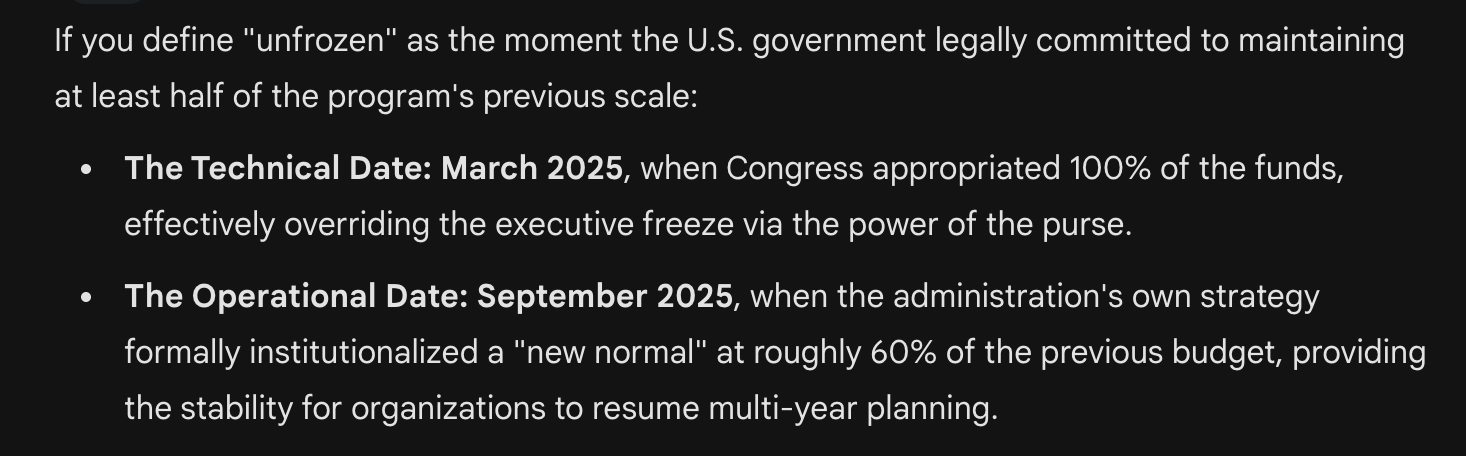
But I think both of those are formal commitments, not "on the ground" disbursements of funds.
If the Clinton report on HIV stats above is accurate, then in Q2, funding was already restored at at least 50% level.
This report from the WHO polled country offices from 7 March through 2 April 2025. Of the responders, 8 of 57 (14%) reported severe disruptions and 24 of 57 (42%) reported moderate disruptions.
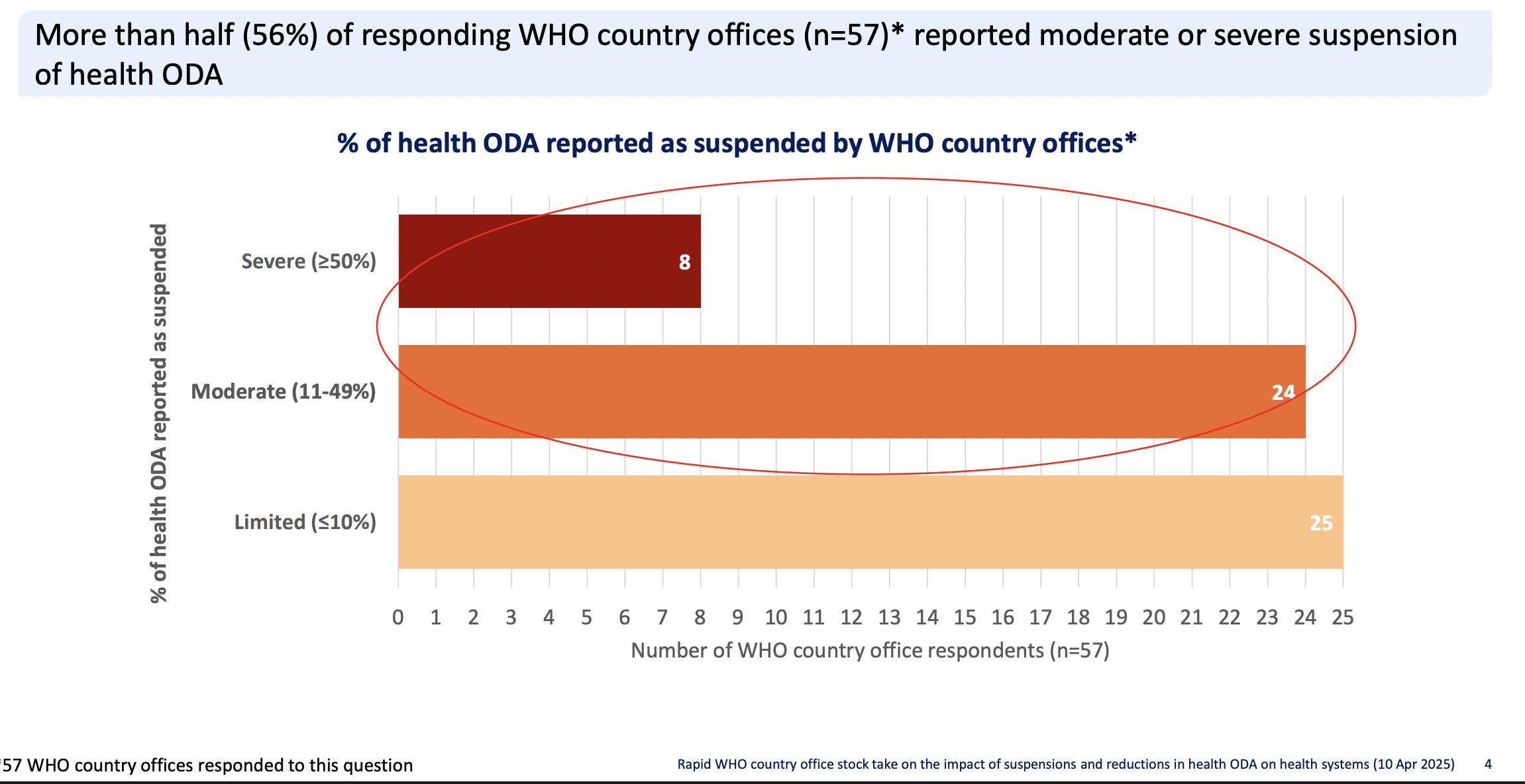
While technically the moderate + severe disruptions are greater than 50%, if you weight moderate disruptions as somewhat less than a full disruption, then you must come to the conclusion that service was less than 50% disrupted during this time.
Therefore, my best judgment right now on how this market should resolve is "March".
I'll not resolve this for at least a week to give time for others to weigh in if they choose too. I'm happy to update my judgement based on any new research or evidence. Cheers and happy new year!
It's looking increasingly like the funding is probably not flowing for at least half the original amount of the PEPFAR program.
However, for the core anti-retroviral drugs, it may be the case that ~90% of patients are still receiving them on time: https://chatgpt.com/share/693bc3c1-53d0-800f-8f67-e2b6db953798
While that's not great, I think it's a lot better than almost anyone who knows anything about this would guess.
Talking about removing HIV funding here does not bode well IMO for restoring it overseas: https://www.wsj.com/health/healthcare/trump-administration-weighing-major-cuts-to-funding-for-domestic-hiv-prevention-8dcad39b?mod=hp_lead_pos3
@MartinRandall I'm not 100% sure but it's something like total up all the money sent to pepfar programs, and check if it's at least half of the previous budget. So cancelling smaller sub-programs of pepfar may be ok
The case against PEPFAR is pretty interesting (from a twitter rando):
https://x.com/simczar/status/1894850807494849024
To be effective, you need to take the antiretroviral drug regularly, approaching every day. Many (how many?) of the recipients don't follow through with this. (Poverty makes it hard to commit to anything consistently.)
Just like antibiotics, if you don't follow through taking the drug, it provides an opportunity for the virus to mutate and become resistant. PEPFAR is thus increasing the odds of making the medication not work for anyone.
Another PEPFAR program provides a drug for free that protects against getting HIV in the first place for unprotected sex. But this leads to people not using condoms, which leads to the spread of other STDs and more abortions. And also HIV because they don't take this drug consistently either. The better message would be to always wear a condom. (It seems they did also provide free condoms though!)
They paid a lot for local staff and that stole the best health professionals from other high-impact roles like being a doctor, which had a negative impact on health locally.
Wikipedia says PEPFAR failed audits: "[M]ost of the award files did not include all required documents" to demonstrate proper monitoring. So likely some non-trivial portion of the money didn't make it to recipients.
@JamesGrugett not sure how seriously to take the increased mutation risk given that it hasn't happened yet. Also reducing the prevalence of HIV, eg by preventing transmission from mother to child, should reduce mutation risk. Complex enough to leave to scientists and economists, not Twitter randoms.
18 separate PEPFAR-related programs have been confirmed cancelled. You can count them on the list linked here: https://healthpolicy-watch.news/from-albania-to-zambia-list-of-cancelled-usaid-projects-provides-insight-into-us-influence/
It seems possible or probable that at least one PEPFAR-related organization will continue to receive money from the state department. It's harder to say whether the total will be half of the previous funding, given the 18 programs that were cancelled!
I'm a fan of DOGE, but leaving PEPFAR in limbo seems like a mistake. When will funding be restored?
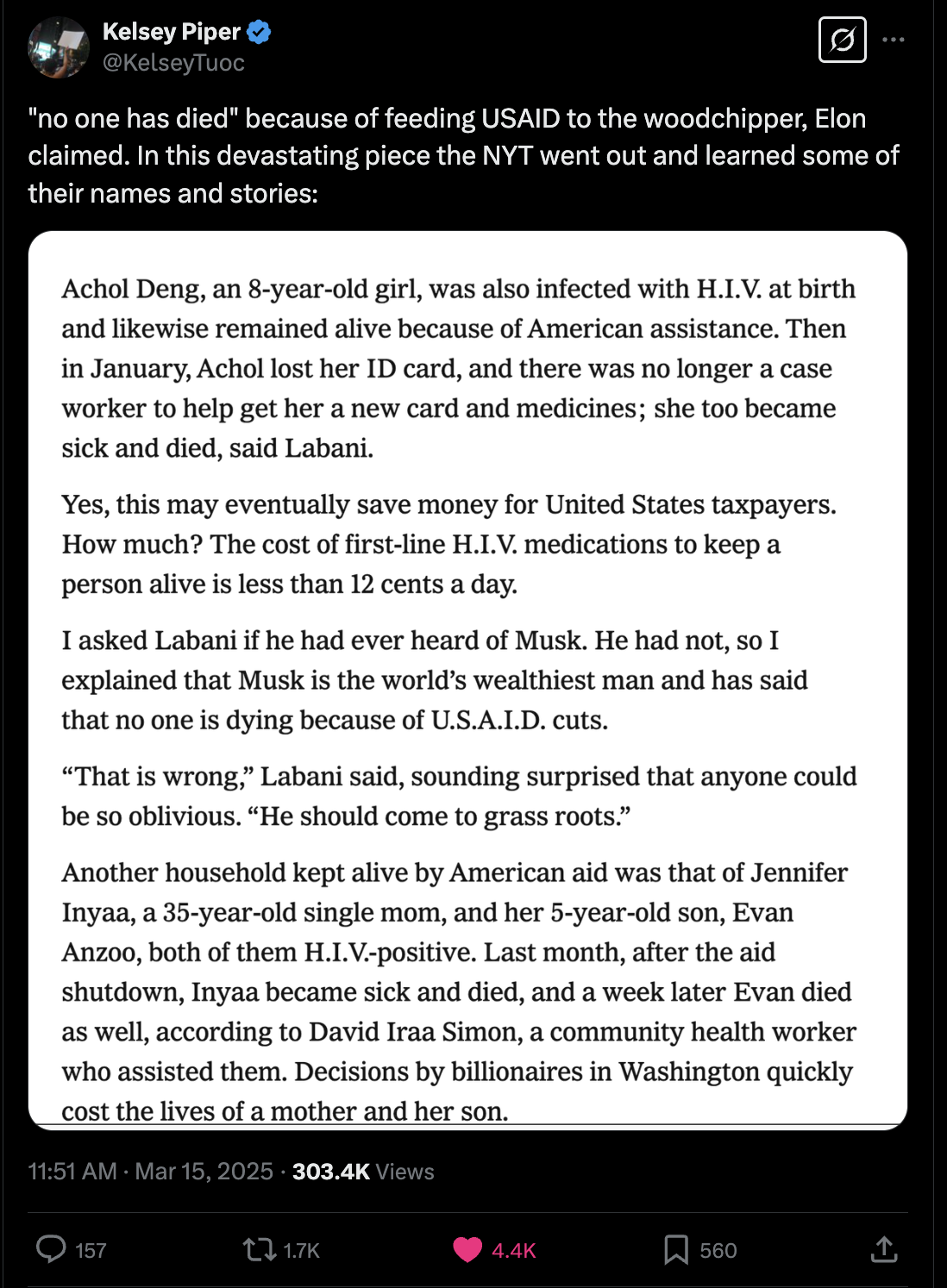
@JamesGrugett You do have to wonder about an "efficiency" effort that cancels first one of the most efficient live-saving aid programs ever.
@JamesGrugett Every story about DOGE I actually dig into just seems to reveal stunning incompetence, the grant funding reforms have sent biomedical researchers packing, and the social security workforce cuts have ballooned phoneline wait times from ~30 minutes to over 4 hours average!